Huawei Solar Inverter Lebanon 2026: Off-Grid & Hybrid Buyer's Guide

Looking for a Huawei solar inverter in Lebanon in 2026? Compare SUN2000 hybrid models, LUNA2000 batteries and LCEC net metering. Order online.
If you're searching for a Huawei solar inverter in Lebanon in 2026, the calculation is no longer about saving on a normal electricity bill — it's about replacing the diesel-generator subscription that has become the de facto power utility in Beirut, Tripoli, Saida, Zahlé and the mountain villages. Électricité du Liban (EDL) typically supplies 3 to 6 hours of grid per day in most areas, and households now spend USD 100 to 300 per month just on a neighbourhood "moteur" subscription, paid in fresh dollars.
This guide is built for Lebanese homeowners, shops, small clinics and EPC installers. We focus on what actually works in Lebanon today: a Huawei SUN2000 hybrid inverter paired with LUNA2000 lithium batteries, sized to run a household through the EDL blackout, cut the moteur bill to zero, and either island completely off-grid or stay LCEC-net-metering compliant when the grid is up.
Ready to buy? Pick the model in the catalogue and order it online.
Products mentioned in this article
Huawei 5 kWh 450 V Lithium Solar Battery LUNA2000-5-S0


- Usable Capacity
- 5 kWh
- Nominal Voltage (Single-Phase)
- 450 V
- Operating Voltage (Single-Phase)
- 350-560 V
Price incl. VATAED 3,228
Huawei 10 kW Three-Phase On-Grid Solar Inverter SUN2000-10KTL-M1

- Rated AC Power
- 10000 W
- Max DC Voltage
- 1100 V
- Operating Voltage Range
- 140-980 V
Price incl. VATAED 4,847
Huawei 5 kW Single-Phase On-Grid Solar Inverter SUN2000-5KTL-L1

- Max DC Voltage
- 600 V
- Startup Voltage
- 100 V
- MPPT Voltage Range
- 90-560 V
Price incl. VATAED 2,801
Huawei 8 kW Three-Phase On-Grid Solar Inverter SUN2000-8KTL-M1
- Rated AC Power
- 8000 W
- Max DC Voltage
- 1100 V
- Operating Voltage Range
- 140-980 V
Price incl. VATAED 4,616
Huawei 10 kWh 450 V Lithium Solar Battery LUNA2000-10-S0
- Usable Capacity
- 10 kWh
- Nominal Voltage (Single-Phase)
- 450 V
- Operating Voltage (Single-Phase)
- 350-560 V
Price incl. VATAED 5,996
Huawei 12 kW Three-Phase On-Grid Solar Inverter SUN2000-12KTL-M5

- Max DC Voltage
- 1100 V
- MPPT Voltage Range
- 200-1000 V
- No. of MPPTs
- 2
Price incl. VATAED 5,309
In a hurry? The 30-second answer
For a typical Lebanese apartment or villa (3–4 rooms, fridge, washing machine, 1–2 split ACs, LED lighting, internet, monthly EDL + moteur of USD 150–250), the Huawei SUN2000-5KTL-L1 single-phase hybrid inverter paired with one or two LUNA2000-5-S0 battery modules (5–10 kWh usable) is the sweet spot for 2026. It runs in pure off-grid mode when EDL is out, charges from solar through the day, supports a backup generator input, and is fully compatible with LCEC's NEERA net-metering framework when EDL is available.
Larger villas, shops or clinics typically step up to the SUN2000-8KTL-M1 or SUN2000-10KTL-M1 three-phase hybrid with 10–15 kWh of LUNA2000 storage. We'll walk through both below.
Why the inverter is the most important component of a Lebanese solar system
In countries with stable grids, the inverter is the part that converts DC to AC. In Lebanon, it is the part that decides whether your fridge stays on tonight, whether your kids do homework on a powered laptop, and whether you still pay the moteur owner USD 200 next month.
Three local realities make the choice in Lebanon different from Europe, the GCC or even Syria/Jordan:
1. EDL is not a backup — it is the secondary source. In a typical 2026 Lebanese home, solar + battery is the primary supply, EDL is the secondary opportunistic charger when it appears, and the diesel moteur is the emergency third option you want to eliminate. The inverter has to be hybrid, with smart battery-first logic, generator-input handling, and the ability to ride through repeated daily grid drop-outs without faulting.
The SUN2000-L1 and SUN2000-M1 series do exactly this: they will switch from grid-tied to off-grid mode in under 20 ms, prioritise self-consumption, and only export to EDL when the battery is full.
2. Dollarisation and capital preservation. Lebanon's economy has been dollarised since the 2019 banking crisis. Customers pay in fresh USD cash and they want hardware that will still be working — and still have spare parts and warranty support — in 2036. Huawei's global FusionSolar service network and a warranty handled through an authorised distributor are decisive arguments here over no-name Chinese brands that flooded the market in 2021–2022 and are now orphaned.
3. Coastal heat and humidity plus mountain cold. Beirut and the coast sit in 30–35°C with 75–85% humidity for half the year; Faraya, Bcharré and the Bekaa drop below freezing in January. The SUN2000 series is rated −25°C to +60°C with IP65 enclosure, which covers both extremes without derating in normal residential conditions.
Why Huawei specifically for Lebanon
Several brands sell into Lebanon — Deye, Growatt, Goodwe, SMA, Voltronic — and each has a place. Here is why Huawei has become the default premium choice in the post-2021 wave:
- SUN2000 reliability under daily cycling. Lebanese systems switch between grid, battery and generator multiple times per day. The SUN2000-L1 and M1 inverters are built around this duty cycle: full hybrid logic, sub-20 ms grid-to-island transfer, generator AC-coupled input.
- LUNA2000 modular battery. Start with one 5 kWh module (LUNA2000-5-S0), expand to 10 or 15 kWh later as your budget allows or your loads grow. Each module has a built-in BMS, optimiser and DC switch. You can mix new and aged modules without losing capacity on the newer one.
- FusionSolar app. Real-time monitoring from your phone, EDL-vs-solar-vs-battery dashboards in Arabic, English and French. Critical for landlords with multiple tenants on the same building system.
- Warranty stated on each product page: 2 years on SUN2000 inverters and 5 years on LUNA2000 batteries, handled through us.
- Spare parts and service. We stock SUN2000 boards, fans, LUNA2000 modules and Smart Dongles in our Dubai warehouse.
Order online: every model in the catalogue shows its price, and checkout takes a minute.
How to size a Huawei system for a Lebanese home
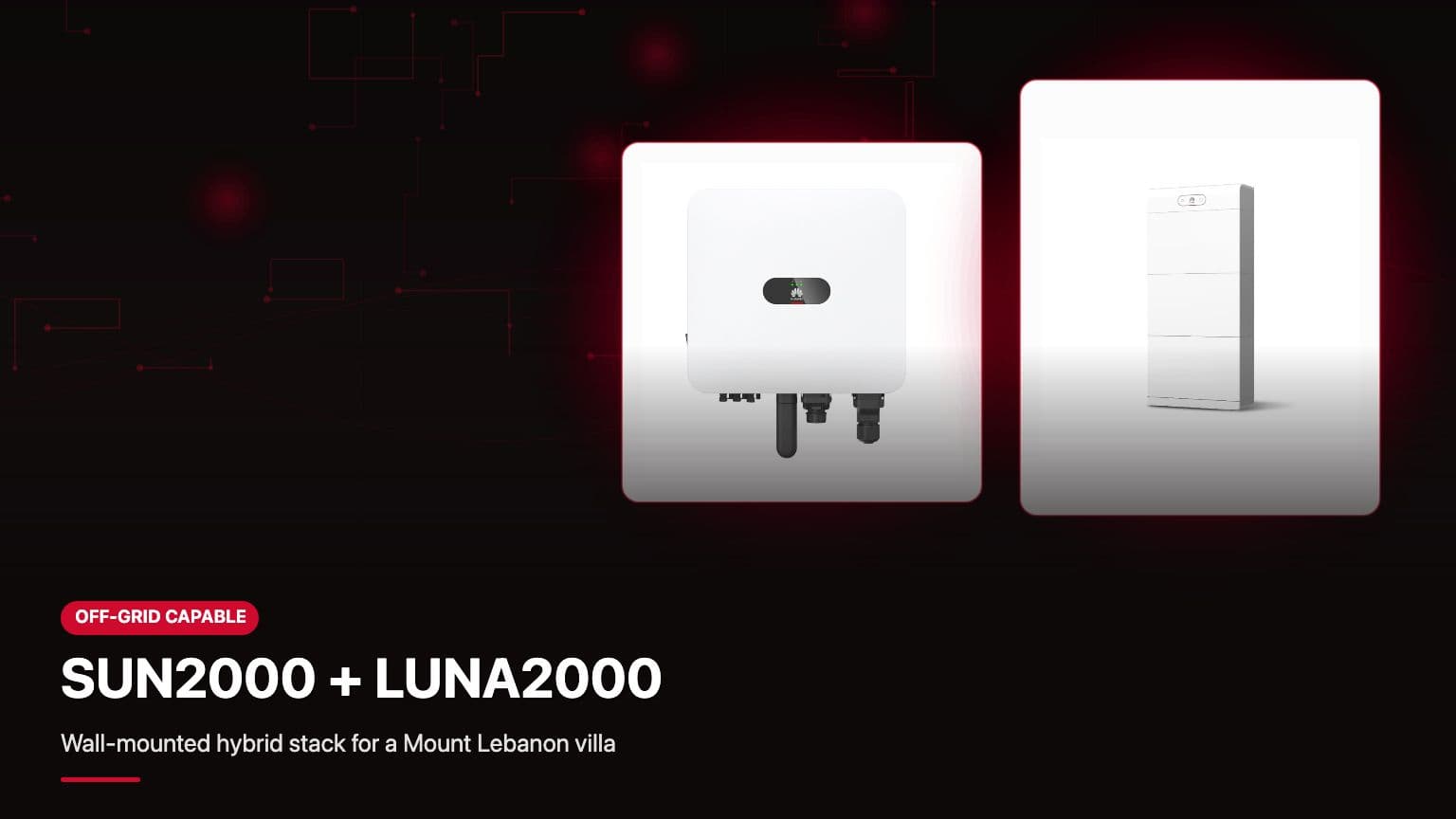
Sizing in Lebanon is driven by two numbers most Gulf or European guides ignore: how many hours of EDL you actually receive, and how much you currently pay the moteur. Use the table below as a starting point, then adjust by 20–30% based on roof area and load schedule.
| Lebanese home profile | EDL + moteur (USD/month) | Recommended Huawei inverter | LUNA2000 battery | PV array |
|---|---|---|---|---|
| Small apartment, 2 rooms, fridge + lights + Wi-Fi | 80–130 | SUN2000-3KTL-L1 (3 kW single-phase hybrid) | 1× LUNA2000-5-S0 (5 kWh) | 3–4 kWp |
| Mid-size apartment / small villa, 3 rooms, 1 AC | 130–220 | SUN2000-5KTL-L1 (5 kW single-phase hybrid) | 1–2× LUNA2000-5-S0 (5–10 kWh) | 5–6 kWp |
| Villa, 4 rooms, 2 ACs, water heater | 220–320 | SUN2000-8KTL-M1 (8 kW three-phase hybrid) | 2× LUNA2000-5-S0 or 1× LUNA2000-10-S0 (10 kWh) | 8–10 kWp |
| Large villa with pool / small clinic / shop | 320–500 | SUN2000-10KTL-M1 or SUN2000-12KTL-M5 (10–12 kW three-phase) | 1× LUNA2000-15-S0 (15 kWh) | 10–14 kWp |
Two practical notes for Lebanon:
- Single-phase vs three-phase. Most older Lebanese buildings have single-phase EDL feeds; new buildings and most villas have three-phase. Match the inverter to the meter, not the other way around.
- Battery sizing is for the EDL gap, not the day. The PV array carries daytime loads; the battery only needs to bridge the 18–21 hours per day when EDL is out and the sun is down. 5–15 kWh covers almost every residential case.
LCEC, NEERA and EDL interconnection in 2026
The Lebanese Center for Energy Conservation (LCEC), working with the Ministry of Energy and Water, runs the country's renewable-energy framework. The NEERA (National Energy Efficiency and Renewable Energy Action) plan defines net-metering rules for residential and small commercial PV systems connected to EDL.
The current Lebanese net-metering scheme allows:
- Residential systems up to 10 kWp on a single-phase EDL feed and up to 1.5 MWp on commercial three-phase, exporting excess generation to EDL.
- Annual credit roll-over: surplus kWh exported in summer offsets winter consumption.
- A bidirectional meter installed by EDL after technical inspection.
- An inverter that complies with anti-islanding (IEC 62116 / IEEE 1547), which the SUN2000-L1 and M1 series satisfy out of the box.
The catch in Lebanon, in 2026, is that EDL availability has eroded the financial case for grid export — there are only a few hours per day to export into, and the import tariff is being restructured. So the practical play is:
- Size the PV array to cover daytime self-consumption + battery charging.
- Register for LCEC / EDL net metering anyway, so any rare surplus is credited.
- Treat the moteur subscription as the real bill to eliminate — not the EDL bill.
Your installer should handle the LCEC application, the EDL technical inspection, and the bidirectional meter swap.
Ready to buy? Pick the model in the catalogue and order it online.
Mistakes to avoid when buying solar in Lebanon
- Buying a "grid-tie" inverter to save money. A pure grid-tie inverter shuts down when EDL is out — which is most of the day. It is the wrong product for Lebanon in 2026. Hybrid only.
- Skipping the battery. The PV array produces only during daylight. Without LUNA2000 (or equivalent) you will still be on the moteur every evening. Battery is non-negotiable.
- Under-sizing the battery for the EDL gap. 5 kWh is the minimum for a 2-room apartment. Don't let an installer talk you into 2.4 kWh "pilot" packs that won't see you through one night.
- Buying orphaned no-name brands. Several brands that sold heavily in Beirut in 2021–2022 are no longer importing into Lebanon and have no local service. Stick with Huawei, Sungrow, Deye, or SMA — manufacturers with a regional after-sales presence.
- Ignoring the LCEC / EDL paperwork. Even if export is currently marginal, you want a legal interconnection so your home insurance is not voided and so you benefit from any future tariff change.
- Installing on a flat roof without proper ballast or fastening. Mediterranean storms in winter and dust-laden khamaseen winds in spring lift poorly mounted panels. Insist on engineered mounting.
- Putting the inverter and battery in direct sun. SUN2000 is IP65 and rated to 60°C, but ambient cooling extends life. A shaded north-facing wall, or a ventilated utility room, is ideal.
Next steps
If you are sizing a Lebanese system, start from three figures: your last EDL bill, the amperage and monthly fee of your moteur subscription, and the roof area. Put them through Build My System for a SUN2000 + LUNA2000 specification, then order it — every unit is priced.
Hardware is collected from our store in Dubai or Riyadh.
Ready to buy? Pick the model in the catalogue and order it online.
Where the grid is absent for most of the day, size as if it were gone: the off-grid house system stores a full day, the sizing calculator lets you set the hours you need, and the SUN2000 LB0 vs MAP0 comparison sets the two hybrid families side by side.
Frequently Asked Questions
Which Huawei inverter is best for a Lebanese home in 2026?
How much does a Huawei solar system cost in Lebanon?
Can I run my house fully off-grid with Huawei in Lebanon?
Does Huawei work with the LCEC / NEERA net-metering scheme?
How does a Huawei system compare with my moteur subscription?
Will Huawei equipment survive Beirut heat and coastal humidity?
- #huawei solar inverter lebanon
- #solar Lebanon
- #EDL
- #LCEC
- #LUNA2000
- #off-grid Lebanon
- #Beirut solar
- #hybrid inverter Lebanon
- #SUN2000
- #NEERA
Ready to order?
Every unit in the catalogue carries its price — add it to the cart and order online, then collect it from our store in Dubai or Riyadh.

