Huawei Solar Inverter Iraq 2026: The Practical Buyer's Guide

Looking for a Huawei solar inverter in Iraq in 2026? SUN2000 and LUNA2000 sizing for Baghdad, Basra and Erbil homes, generator integration, and MoE interconnection notes.
If you are searching for a Huawei solar inverter in Iraq in 2026, you are not buying a luxury. You are buying a way out of a 20-year-old problem: a national grid that delivers 6 to 14 hours of power a day in summer, neighborhood diesel generators that quietly drain 25,000 to 50,000 IQD per ampere per month from your household budget, and ambient temperatures that routinely cross 50°C in Baghdad and Basra. The right inverter decides whether you keep paying the "ampere subscription" forever or own your electricity by 2030.
This guide is built for Iraqi homeowners, shop owners, and small-commercial buyers in Baghdad, Basra, Erbil, Mosul, Najaf, Karbala and the surrounding governorates. We focus on Huawei's SUN2000 single-phase and three-phase residential lineup, the LUNA2000 battery family, and the practical realities of running a hybrid system in Iraq — heat, dust, generator integration, and the Iraq Ministry of Electricity (MoE) interconnection process under the country's 7.5 GW solar roadmap.
Ready to buy? Pick the model in the catalogue and order it online.
Products mentioned in this article
Huawei 10 kWh 450 V Lithium Solar Battery LUNA2000-10-S0


- Usable Capacity
- 10 kWh
- Nominal Voltage (Single-Phase)
- 450 V
- Operating Voltage (Single-Phase)
- 350-560 V
Price incl. VATAED 5,996
Huawei 15 kWh 450 V Lithium Solar Battery LUNA2000-15-S0
- Usable Capacity
- 15 kWh
- Nominal Voltage (Single-Phase)
- 450 V
- Operating Voltage (Single-Phase)
- 350-560 V
Price incl. VATAED 8,777
Huawei 8 kW Three-Phase On-Grid Solar Inverter SUN2000-8KTL-M1

- Rated AC Power
- 8000 W
- Max DC Voltage
- 1100 V
- Operating Voltage Range
- 140-980 V
Price incl. VATAED 4,616
Huawei 10 kW Three-Phase On-Grid Solar Inverter SUN2000-10KTL-M1
- Rated AC Power
- 10000 W
- Max DC Voltage
- 1100 V
- Operating Voltage Range
- 140-980 V
Price incl. VATAED 4,847
Huawei 12 kW Three-Phase On-Grid Solar Inverter SUN2000-12KTL-M5

- Max DC Voltage
- 1100 V
- MPPT Voltage Range
- 200-1000 V
- No. of MPPTs
- 2
Price incl. VATAED 5,309
Huawei 5 kWh 450 V Lithium Solar Battery LUNA2000-5-S0
- Usable Capacity
- 5 kWh
- Nominal Voltage (Single-Phase)
- 450 V
- Operating Voltage (Single-Phase)
- 350-560 V
Price incl. VATAED 3,228
In a hurry? The 30-second answer
For a typical Iraqi home (3 bedrooms, 2 split ACs, fridge, freezer, lights, well pump) with a monthly generator bill around 250,000–450,000 IQD, the Huawei SUN2000-8KTL-M1 hybrid inverter paired with a LUNA2000-10-S0 battery (10 kWh) is the strongest 2026 pick on price-to-performance. It runs up to 60°C with controlled derating, carries IP65 protection against Iraqi dust and humidity, accepts a generator AC input for hybrid backup, and is fully compatible with MoE single-point interconnection guidelines for rooftop PV.
If you live in Basra (higher heat, higher cooling load) or run a small shop (longer evening hours, fridges), we will show you exactly when to step up to the SUN2000-10KTL-M1 or SUN2000-12KTL-M5 with a LUNA2000-15-S0 battery. Skip to the sizing table by city or read the full guide below.
Why solar matters more in Iraq than almost anywhere else
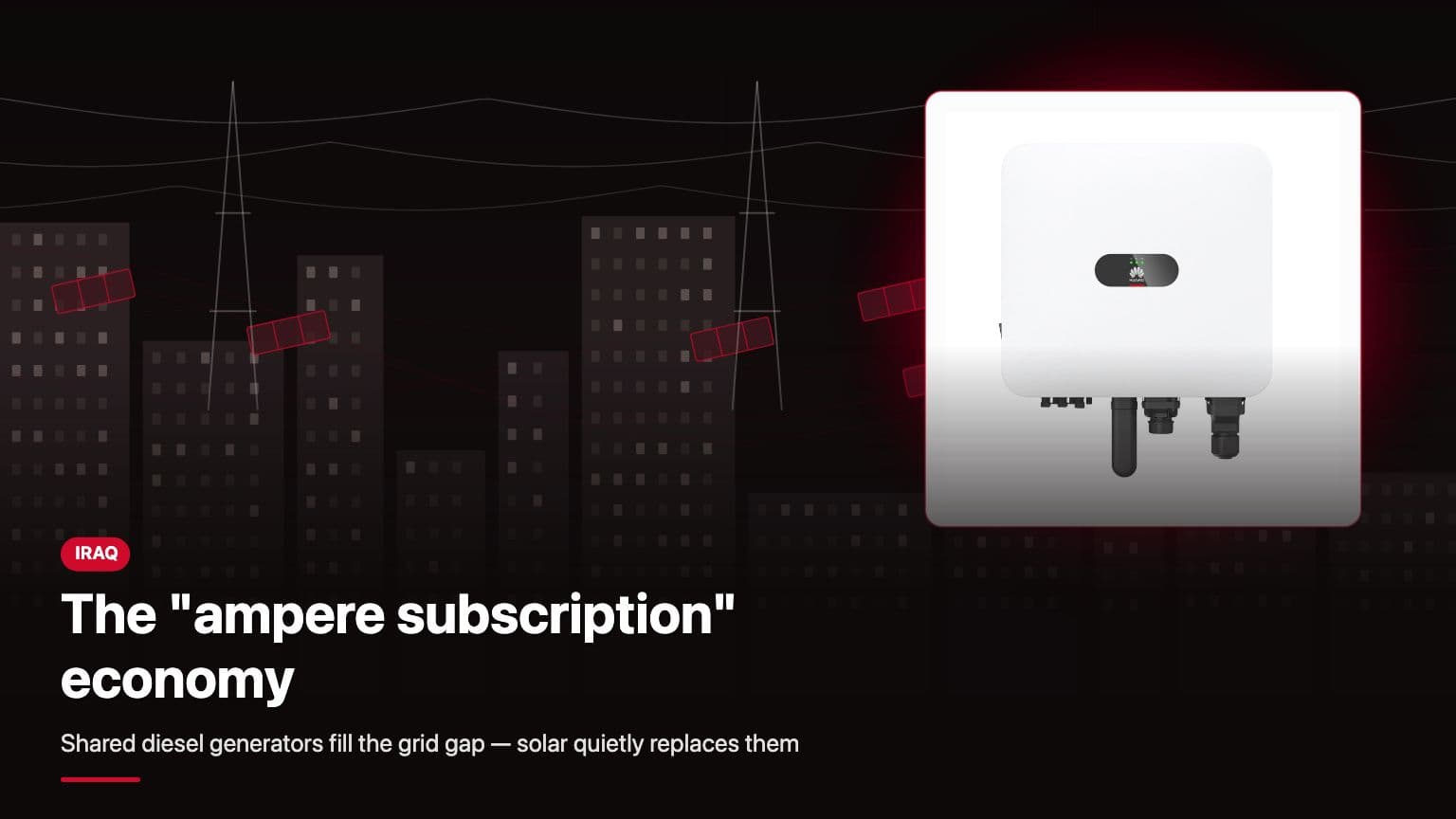
Three local realities make solar in Iraq a fundamentally different conversation from solar in Europe or even the Gulf.
1. The grid is unreliable, especially in summer. Iraq's installed generation capacity sits well below peak demand. In July and August, Baghdad neighborhoods typically receive 6–12 hours of grid power a day. Basra is often worse — 4–10 hours during heatwaves. The Kurdistan Region (Erbil, Sulaymaniyah, Duhok) is the best-served, with 16–22 hours on most days, but it still suffers brownouts when demand spikes. The federal Ministry of Electricity is building capacity, but the gap between supply and demand in Iraq's summer is structural and won't close before 2030.
2. The "ampere subscription" economy. Most Iraqi homes pay a neighborhood diesel-generator operator a monthly fee per ampere of guaranteed backup. Typical pricing in 2026 sits at 25,000–50,000 IQD per ampere per month, depending on city, fuel price, and generator hours. A normal household buying 5 amperes pays 125,000–250,000 IQD a month — and the generator still cuts out for hours every day. That single line item is the largest recurring household energy expense in the country, and it is exactly what a Huawei hybrid system replaces.
3. Brutal summer heat. Baghdad regularly hits 48–52°C in July. Basra has recorded 53°C+. Inverters not rated for that heat lose 15–30% of their summer-afternoon output right when you need it most — when every AC in the house is running. This is where Huawei's SUN2000 thermal design specifically pays off.
Why Huawei specifically — and not "any" inverter
Iraqi importers ship dozens of inverter brands. Most are not designed for 50°C continuous ambient operation, and many cut corners on transformer isolation, surge protection, and battery firmware compatibility. Huawei sits at the top of the global string-inverter market for measurable reasons that translate directly to Iraqi conditions:
- Operating range up to 60°C ambient. The SUN2000 residential family is rated for −25°C to +60°C, with derating starting only at 45°C. Translation: a properly mounted SUN2000 in Baghdad keeps producing into the 52°C afternoons that disable cheaper inverters.
- IP65 enclosure. Dust-tight + protected against water jets. Critical for Iraq's combination of fine summer dust, winter rain in the north, and high coastal humidity in Basra.
- LUNA2000 modular battery. Stack from 5 kWh (LUNA2000-5-S0) to 10 kWh (LUNA2000-10-S0) to 15 kWh (LUNA2000-15-S0) and parallel further. LiFePO₄ chemistry, 5-year warranty, IP66 rated battery modules, and onboard optimizers that keep each module balanced — important because Iraqi homes draw battery cycles hard during outages.
- FusionSolar app in Arabic. Monitoring app supports Arabic and English, push notifications for outages and battery state, and remote diagnostics so installers can troubleshoot without driving across Baghdad in 50°C traffic.
- Generator-friendly hybrid logic. The SUN2000 hybrid models accept a generator AC input with auto-start signaling, so existing neighborhood-feed or villa-owned diesel sets can coexist with the solar system.
- Iraq-relevant compliance. Huawei inverters meet IEC 62109, IEC 61727, IEC 62116 and the broader anti-islanding standards referenced by the Iraq Ministry of Electricity and the Iraq National Investment Commission in rooftop and IPP tenders.
To buy, open the catalogue, add the model to the cart and check out online.
Sizing for Iraqi homes by city
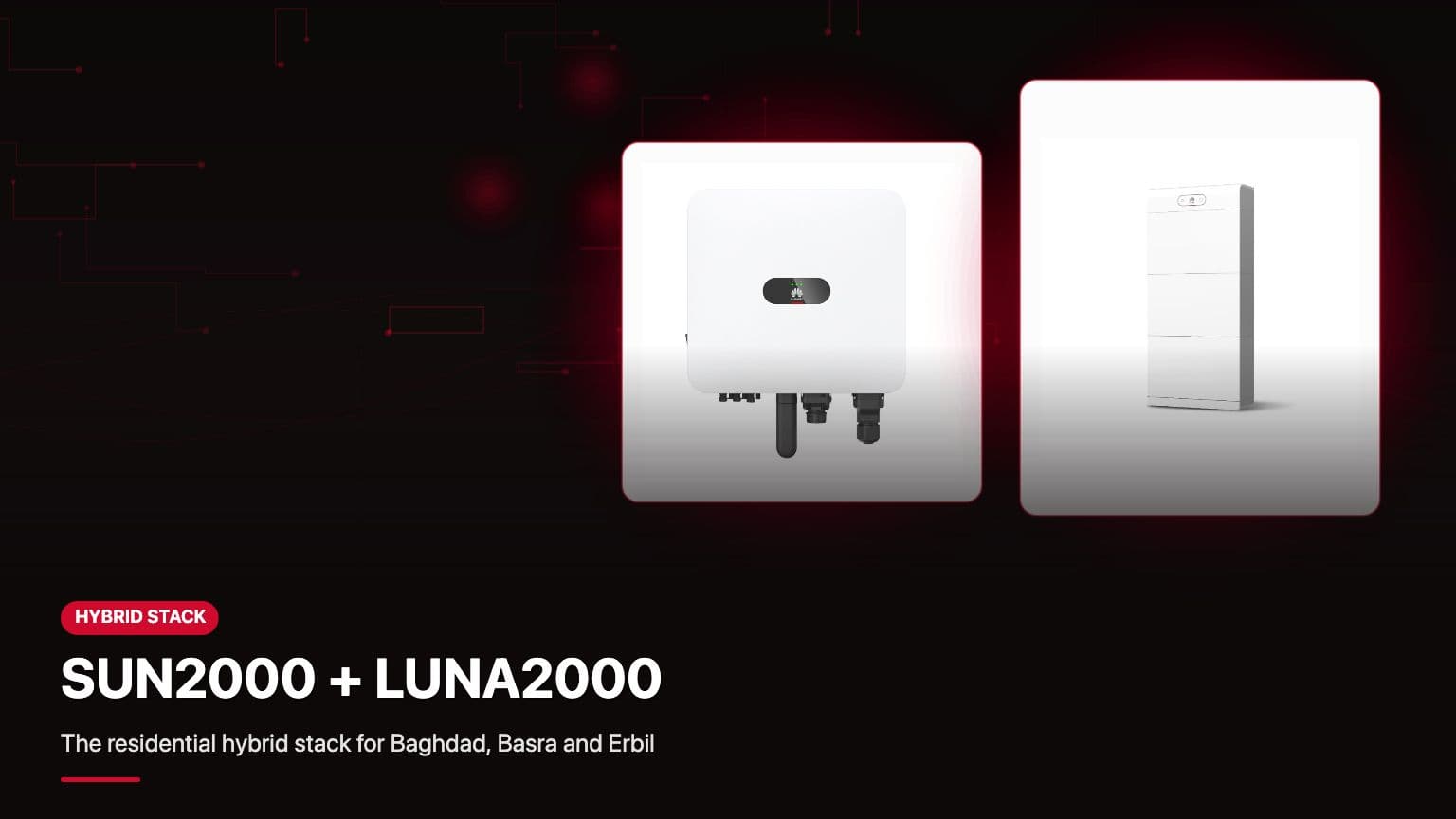
Sizing in Iraq is driven less by your MoE bill (which is subsidized and small) and more by your generator bill and your peak simultaneous AC load. Use this lookup as a starting point:
| Home profile | City example | Monthly generator bill (IQD) | Recommended inverter | Battery |
|---|---|---|---|---|
| Apartment, 1–2 ACs, basic loads | Erbil, Najaf | 100,000–180,000 | SUN2000-3KTL-L1 (3 kW single-phase hybrid) | LUNA2000-5-S0 (5 kWh) |
| Small home, 2 ACs, fridge, well pump | Baghdad, Mosul | 150,000–280,000 | SUN2000-5KTL-L1 (5 kW single-phase hybrid) | LUNA2000-5-S0 to 10-S0 (5–10 kWh) |
| Mid-size villa, 3 ACs, freezer, well pump | Baghdad, Karbala | 250,000–400,000 | SUN2000-8KTL-M1 (8 kW three-phase hybrid) | LUNA2000-10-S0 (10 kWh) |
| Large villa, 4+ ACs, pool, electric oven | Basra, Baghdad suburbs | 400,000–700,000 | SUN2000-10KTL-M1 or SUN2000-12KTL-M5 | LUNA2000-15-S0 (15 kWh) |
| Small shop / pharmacy / clinic | Any city | 500,000–900,000 | SUN2000-15KTL-M5 (15 kW three-phase) | LUNA2000-15-S0 + expansion (15–25 kWh) |
Two adjustments matter:
- Basra and Maysan governorates. Add ~15% to inverter and battery capacity. Heat and cooling load are both higher, and grid availability is among the worst in Iraq.
- Erbil and Kurdistan Region. You can size 10–15% smaller in some cases. Grid uptime is materially better, so the system is doing more grid-tie self-consumption and less deep-cycle battery work.
Iraq grid code and Ministry of Electricity interconnection
Iraq is in the middle of building out the regulatory layer around rooftop solar. Three things are worth knowing in 2026:
1. Federal framework. The Iraq Ministry of Electricity (MoE) has issued interconnection guidance for rooftop PV with anti-islanding protection, single-point connection at the household meter, and limits on export back to the distribution feeder. Huawei SUN2000 inverters meet the underlying IEC standards (62109, 61727, 62116) referenced in MoE guidance.
2. Iraq's 7.5 GW solar plan. The Iraq National Investment Commission (NIC) has launched a multi-phase 7.5 GW solar program covering utility-scale projects like the Al Khairat (Karbala), Mawsil (Mosul) and Muthanna tenders. These are not directly relevant to a homeowner, but they matter because they are pulling down panel prices, training local EPC labor, and accelerating customs clearance for solar hardware including Huawei inverters.
3. Net-metering is partial and city-dependent. True net metering and net billing are not yet rolled out uniformly across Iraqi governorates. In Kurdistan Region, several pilot programs allow grid-tie systems with informal back-feed. In federal Iraq, the practical play is self-consumption first, battery storage second, minimal or zero export. This is exactly the operating mode the Huawei SUN2000 hybrid is optimized for.
Practically: install hybrid, maximize daytime self-consumption and battery charging, run essential loads from battery at night, and use grid (when available) only for top-off.
Mistakes to avoid when buying a Huawei solar system in Iraq
- Buying a grid-tie-only inverter to save money. In Iraq this is the single most expensive mistake possible. With no battery, you lose all production during the daily grid outages — which are exactly when your AC needs the power. Always go hybrid.
- Undersizing the battery. A 5 kWh battery on a 4-AC villa in Basra will be drained within 90 minutes of grid loss. Match battery capacity to your evening AC load, not just to the inverter's nameplate.
- Skipping the generator AC input. Even if you plan to drop the generator, keeping the AC input wired for the first 12 months is cheap insurance. Iraqi heatwaves create multi-day gray-grid events where the battery alone may not be enough.
- Mounting the inverter in direct sun. IP65 protects against dust and water — it does not exempt you from physics. Install on a shaded outdoor wall, north or east facing if possible, with 200 mm clearance on all sides for airflow.
- Buying inverters and batteries from different brands without checking firmware. Mixing Huawei SUN2000 with a third-party battery via generic CAN protocol is technically possible but produces warranty headaches. Stay within the LUNA2000 ecosystem unless you have a specific reason to leave it.
- Ignoring customs and warranty channels. Inverters imported through grey channels into Iraq frequently arrive with voided warranties. Confirm with the seller that the serial number is registered in Huawei's regional database and that warranty service runs through an authorized Gulf or Iraq partner.
- Skipping the surge protection device (SPD). Iraqi grid voltage transients are far worse than European or Gulf norms. An SPD on the AC side keeps a single bad evening from destroying the inverter.
Ready to buy? Pick the model in the catalogue and order it online.
Frequently asked questions
Which Huawei solar inverter is best for a home in Iraq?
For most homes in Baghdad, Mosul or Najaf, the SUN2000-5KTL-L1 (single-phase) or SUN2000-8KTL-M1 (three-phase) paired with a LUNA2000-10-S0 battery is the best fit. Basra and large villas typically step up to the SUN2000-10KTL-M1 or SUN2000-12KTL-M5 with a LUNA2000-15-S0 battery.
Will a Huawei inverter survive 52°C summers in Baghdad and Basra?
Yes, when installed correctly. The SUN2000 residential lineup is rated to 60°C ambient. Mount on a shaded outdoor wall with airflow clearance and the unit operates with minimal derating through Iraqi summers.
Can I keep my neighborhood diesel generator and add Huawei solar?
Yes. The SUN2000 hybrid models accept a generator AC input with auto-start signaling. Keeping the generator wired for the first year is a sensible backup while you confirm the battery sizing.
What does a Huawei 8 kW hybrid system cost in Iraq in 2026?
The installed cost depends on the panels, the mounting and wiring, and the installer you hire. The current prices of the SUN2000-8KTL-M1 inverter and the LUNA2000-10-S0 battery are shown on their product pages.
Does the Iraq Ministry of Electricity allow rooftop solar?
Yes. MoE has issued interconnection guidance for rooftop PV with anti-islanding and single-point metering. Net-metering rollout is partial and city-dependent in 2026, so most Iraqi systems are configured for self-consumption first and minimal grid export.
Is the warranty valid in Iraq?
Huawei SUN2000 inverters carry a 2-year warranty and LUNA2000 batteries a 5-year warranty, as stated on each product page. Always confirm that your seller registers the serial number in Huawei's regional database at the time of sale.
How long does the installation take?
A typical 5–8 kW Huawei residential install in Iraq takes 1–2 working days for the physical installation plus 1 day for commissioning and FusionSolar app pairing. Larger 12–15 kW systems take 2–4 working days.
Next steps
For after-sales help, our contact page lists our phone and email.
With long daily cuts, the battery line decides an Iraqi system: the house system with overnight backup counts eight hours, the sizing calculator works with Iraq's 5.4 peak sun hours, and the Huawei vs Deye comparison page sets Huawei and Deye side by side.
Frequently Asked Questions
Which Huawei solar inverter is best for a home in Iraq?
Will a Huawei inverter survive 52°C summers in Baghdad and Basra?
Can I keep my neighborhood diesel generator and add Huawei solar?
What does a Huawei 8 kW hybrid system cost in Iraq in 2026?
Does the Iraq Ministry of Electricity allow rooftop solar?
Is the Huawei warranty valid in Iraq?
How long does a Huawei solar installation take in Iraq?
- #huawei solar inverter iraq
- #solar Iraq
- #Baghdad solar
- #Basra solar
- #hybrid inverter Iraq
- #LUNA2000
- #SUN2000
- #generator replacement Iraq
- #Iraq Ministry of Electricity
- #Erbil solar
Ready to order?
Every unit in the catalogue carries its price — add it to the cart and order online, then collect it from our store in Dubai or Riyadh.


