Huawei Solar Inverter Morocco 2026: ONEE Net Metering Buyer's Guide

Sizing and ONEE interconnection for Huawei SUN2000 + LUNA2000 systems in Morocco — Casablanca, Rabat, Marrakech, Tangier. FusionSolar monitoring, Law 13-09 compliance. Order online.
If you're looking at a Huawei solar inverter in Morocco in 2026, you're buying into a national energy transition that's already half-built. The Plan Solaire Marocain (Moroccan Solar Plan) is targeting 52% renewable installed capacity by 2030, the Noor Ouarzazate complex is the largest concentrated solar plant on Earth, and ONEE has finally opened low-voltage net metering to residential and small-commercial customers under Law 13-09 and its 2023 amendments.
This guide is for Moroccan villa owners, riads, small-commercial buyers and EPC installers from Casablanca to Tangier, Rabat, Marrakech, Agadir and the southern provinces. We focus on what actually matters when you specify a Huawei system here: ONEE interconnection paperwork, MASEN vs ONEE roles, sizing for a 40°C+ Marrakech summer, and which SUN2000 models pair with LUNA2000 batteries for self-consumption.
Order online: every model in the catalogue shows its price, and checkout takes a minute.
Products mentioned in this article
Huawei 5 kW Single-Phase On-Grid Solar Inverter SUN2000-5KTL-L1


- Max DC Voltage
- 600 V
- Startup Voltage
- 100 V
- MPPT Voltage Range
- 90-560 V
Price incl. VATAED 2,801
Huawei 15 kW Three-Phase On-Grid Solar Inverter SUN2000-15KTL-M5

- Max DC Voltage
- 1100 V
- MPPT Voltage Range
- 200-1000 V
- No. of MPPTs
- 2
Price incl. VATAED 5,593
Huawei 8 kW Three-Phase On-Grid Solar Inverter SUN2000-8KTL-M1

- Rated AC Power
- 8000 W
- Max DC Voltage
- 1100 V
- Operating Voltage Range
- 140-980 V
Price incl. VATAED 4,616
Huawei 5 kWh 450 V Lithium Solar Battery LUNA2000-5-S0

- Usable Capacity
- 5 kWh
- Nominal Voltage (Single-Phase)
- 450 V
- Operating Voltage (Single-Phase)
- 350-560 V
Price incl. VATAED 3,228
Huawei 10 kW Three-Phase On-Grid Solar Inverter SUN2000-10KTL-M1
- Rated AC Power
- 10000 W
- Max DC Voltage
- 1100 V
- Operating Voltage Range
- 140-980 V
Price incl. VATAED 4,847
Huawei 12 kW Three-Phase On-Grid Solar Inverter SUN2000-12KTL-M5
- Max DC Voltage
- 1100 V
- MPPT Voltage Range
- 200-1000 V
- No. of MPPTs
- 2
Price incl. VATAED 5,309
In a hurry? The 30-second answer
For a typical Moroccan villa (3–5 bedrooms, 2–3 split ACs, monthly ONEE bill 1,200–2,800 MAD), the Huawei SUN2000-8KTL-M1 three-phase residential inverter paired with one or two LUNA2000-5-S0 battery modules (5 or 10 kWh) is the strongest 2026 pick. It hits 98.6% European efficiency, runs to 60°C ambient with controlled derating, integrates the optimiser ecosystem for shaded Marrakech and Fes rooftops, and is on ONEE's approved equipment list for the Law 13-09 / 40-19 net-metering scheme on low and medium voltage.
If you live in an apartment (single-phase), the SUN2000-5KTL-L1 is the right entry point. For larger villas with pools or a small farm in the Souss valley, step up to the SUN2000-12KTL-M5 or SUN2000-15KTL-M5. Detail below.
Why solar matters in Morocco — Plan Solaire Marocain and the 52% target
Morocco is the only North African country that imports more than 90% of its energy and is simultaneously a global renewable leader. That tension is what makes the residential solar market here interesting: ONEE diesel and imported gas costs feed directly into the tariff you pay, and every kWh you produce on your own roof is a kWh you don't import.
Three numbers anchor the policy backdrop:
1. 52% renewable installed capacity by 2030. The Plan Solaire Marocain (originally a 2,000 MW solar mandate launched in 2009) now sits inside a broader 52% renewable target — split roughly between solar, wind and hydro. As of 2026, renewables already account for over 40% of installed capacity. The remaining gap is what drives MASEN's tender pipeline and ONEE's distribution upgrades.
2. Noor Ouarzazate. The 580 MW Noor Ouarzazate complex remains the largest single-site concentrated solar facility in the world, combining CSP (parabolic trough + tower) with PV. It is the visible centrepiece of the policy, but the more relevant trend for homeowners is the PV pipeline — Noor Midelt I and II, Noor Atlas, Noor Tafilalt — which is shifting MASEN's procurement decisively toward bifacial PV with battery storage.
3. The 28% AC self-consumption target. ONEE has publicly stated that distributed self-consumption should reach 28% of national consumption by 2030. That target is what unlocked the low-voltage net-metering changes finalised in 2023 and 2024 and re-priced in early 2026.
For a homeowner in Casablanca or Rabat, the practical takeaway is simple: ONEE tariffs are climbing, and ONEE finally lets you offset them legally.
ONEE, MASEN, ANRE — who regulates what
A common question from new Moroccan buyers is "who do I actually deal with?" The answer is split between three bodies, and getting them wrong delays your interconnection by weeks.
ONEE — Office National de l'Electricité et de l'Eau Potable
- Role: the national distribution utility. ONEE owns the meter, the connection, and the net-billing arrangement.
- What they handle for you: approval of your installation under Law 13-09 (renewables) and Law 40-19 (medium-voltage amendment), the bi-directional meter swap, your monthly bill credits.
- Your installer's interface: ONEE regional agencies (Casablanca, Rabat, Marrakech, Tangier, Agadir, Fes, Oujda) accept the dossier; technical approval is centralised.
MASEN — Moroccan Agency for Sustainable Energy
- Role: utility-scale renewable procurement. MASEN runs the Noor tenders and large PV/CSP/wind projects.
- Relevance to homeowners: low — MASEN doesn't touch residential interconnection, but its tariff benchmarks (now under 0.30 MAD/kWh for utility-scale PV) push the broader cost curve down.
ANRE — Autorité Nationale de Régulation de l'Électricité
- Role: the independent electricity regulator, created by Law 48-15 and operational since 2021.
- Relevance: ANRE sets the access conditions for the medium and high-voltage transmission grid and arbitrates disputes. For residential buyers, ANRE matters when you scale a multi-site or commercial installation across regions.
For 95% of villa and small-commercial buyers, ONEE is the only entity you'll talk to. Your installer files the dossier, ONEE approves the equipment list and the bidirectional meter, and you start exporting.
Law 13-09, Law 40-19 and the 2024 low-voltage opening

Law 13-09 (the 2010 framework law on renewable energy) is the foundation. It legalised private generation and grid sale. But for years, only high and medium-voltage producers could realistically use it — residential rooftops were effectively locked out.
Three changes opened the residential market:
- Law 40-19 (2021) extended self-consumption to the medium-voltage network, opening the door for small commercial and industrial. It also clarified the export tariff calculation.
- 2023 ministerial decrees created an implementing framework for low-voltage self-consumption — the legal basis for villa and apartment rooftop solar feeding ONEE.
- 2024–2026 ONEE technical bulletins finalised the approved equipment list, the bidirectional meter specifications, and the export tariff formula. By early 2026, the application process is finally a paperwork exercise rather than a regulatory negotiation.
The mechanism is closer to net billing than pure net metering: you offset your consumption first (self-consumption at full retail value), and any net export over the billing period is credited at a published export tariff, which is lower than the retail tariff. As in Saudi Arabia and the UAE, this maths makes self-consumption with a battery far more economic than pure export.
Why Huawei specifically — SUN2000, LUNA2000 and FusionSolar
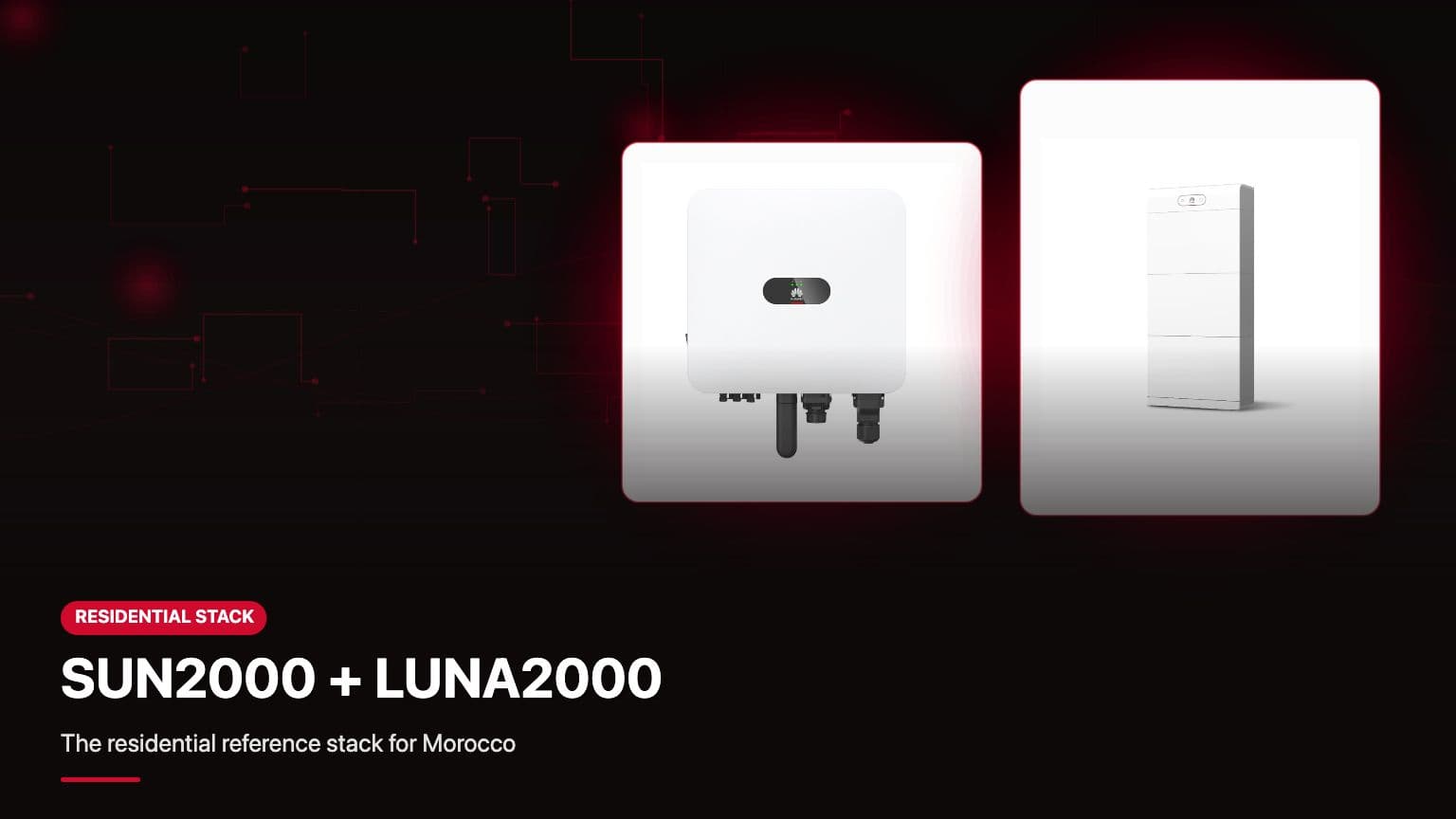
Huawei's residential PV portfolio is built around three pillars, and all three matter in Morocco:
1. SUN2000 hybrid inverters
- Single-phase (apartments, small villas): SUN2000-3KTL-L1, SUN2000-5KTL-L1.
- Three-phase (mid villas): SUN2000-8KTL-M1, SUN2000-10KTL-M1.
- Three-phase (large villas / small commercial): SUN2000-12KTL-M5, SUN2000-15KTL-M5.
- Operating range: −25°C to +60°C, derating begins at 45°C. In a Marrakech or Errachidia summer (40–46°C ambient), this matters — most cheaper inverters start cutting output at 40°C.
- Efficiency: 98.6% European efficiency across the M1 and M5 series.
- Enclosure: IP65 across the residential range, suitable for outdoor wall-mount installation.
2. LUNA2000 battery modules
- LUNA2000-5-S0: 5 kWh stackable LFP module. Stack up to three units (15 kWh) per battery rack.
- LUNA2000-10-S0: 10 kWh integrated unit for larger residential installations.
- Chemistry: lithium iron phosphate (LFP) — the right choice for Moroccan summer heat, with a higher thermal runaway threshold than NMC.
- Warranty: 5 years, as stated on the product page.
3. FusionSolar monitoring
- Cloud + mobile app with Arabic, French and English interface — Morocco-relevant because most installers report to clients in French or Darija.
- Per-string and per-module monitoring (when paired with Huawei optimisers) — useful for partially shaded Fes medina rooftops or terraced riads where panel-level diagnostics save service calls.
- Smart Power Sensor integration for accurate self-consumption tracking and ONEE export logging.
What you're really buying with Huawei is the integration: SUN2000 inverter, LUNA2000 battery, optimisers, smart sensor and FusionSolar app, all from one vendor with a single warranty channel. That matters in Morocco where installer networks are still maturing — fewer cross-vendor fingers to point when something goes wrong.
Sizing a Huawei system for a Moroccan villa
Sizing comes down to three numbers: your average daily kWh, your peak simultaneous AC and pool-pump load, and whether your priority is self-consumption (battery-heavy) or export (panel-heavy). Here is a quick lookup for Casablanca, Rabat, Marrakech, Tangier and Agadir:
| Moroccan home profile | Monthly ONEE bill (MAD) | Recommended Huawei inverter | LUNA2000 battery |
|---|---|---|---|
| Apartment / small flat, 1–2 ACs | 500–900 | SUN2000-3KTL-L1 (3 kW single-phase) | 5 kWh (1 × LUNA2000-5-S0) |
| Small villa, 2 bedrooms, 2 ACs | 900–1,400 | SUN2000-5KTL-L1 (5 kW single-phase) | 5–10 kWh |
| Mid villa, 3–4 bedrooms, 2–3 ACs | 1,500–2,500 | SUN2000-8KTL-M1 (8 kW three-phase) | 10–15 kWh |
| Large villa, 5+ bedrooms, 3+ ACs, pool | 2,500–4,500 | SUN2000-10KTL-M1 or 12KTL-M5 | 15–20 kWh |
| Riad, small hotel, small commercial | 4,000–8,000 | SUN2000-15KTL-M5 (15 kW three-phase) | 20–30 kWh |
| Souss valley farm / pumping | 5,000+ | SUN2000-15KTL-M5 (parallel) or 20KTL-M2 | 20–40 kWh |
Three adjustments specific to Morocco:
- Marrakech and the south: add 5–10% panel capacity to compensate for summer thermal derating above 45°C ambient. The SUN2000 itself handles the heat, but module temperature coefficient still costs you yield.
- Tangier and Atlantic coast: humidity + salt air. Specify panels with anti-PID coating and IP68 connectors. SUN2000 IP65 enclosure is fine, but cable glands must be torqued correctly.
- Atlas mountain villages: bidirectional ONEE meter availability is patchier — confirm with your regional ONEE agency before sizing for export. Many Atlas installs run off-grid or self-consumption-only.
ONEE interconnection — the step-by-step
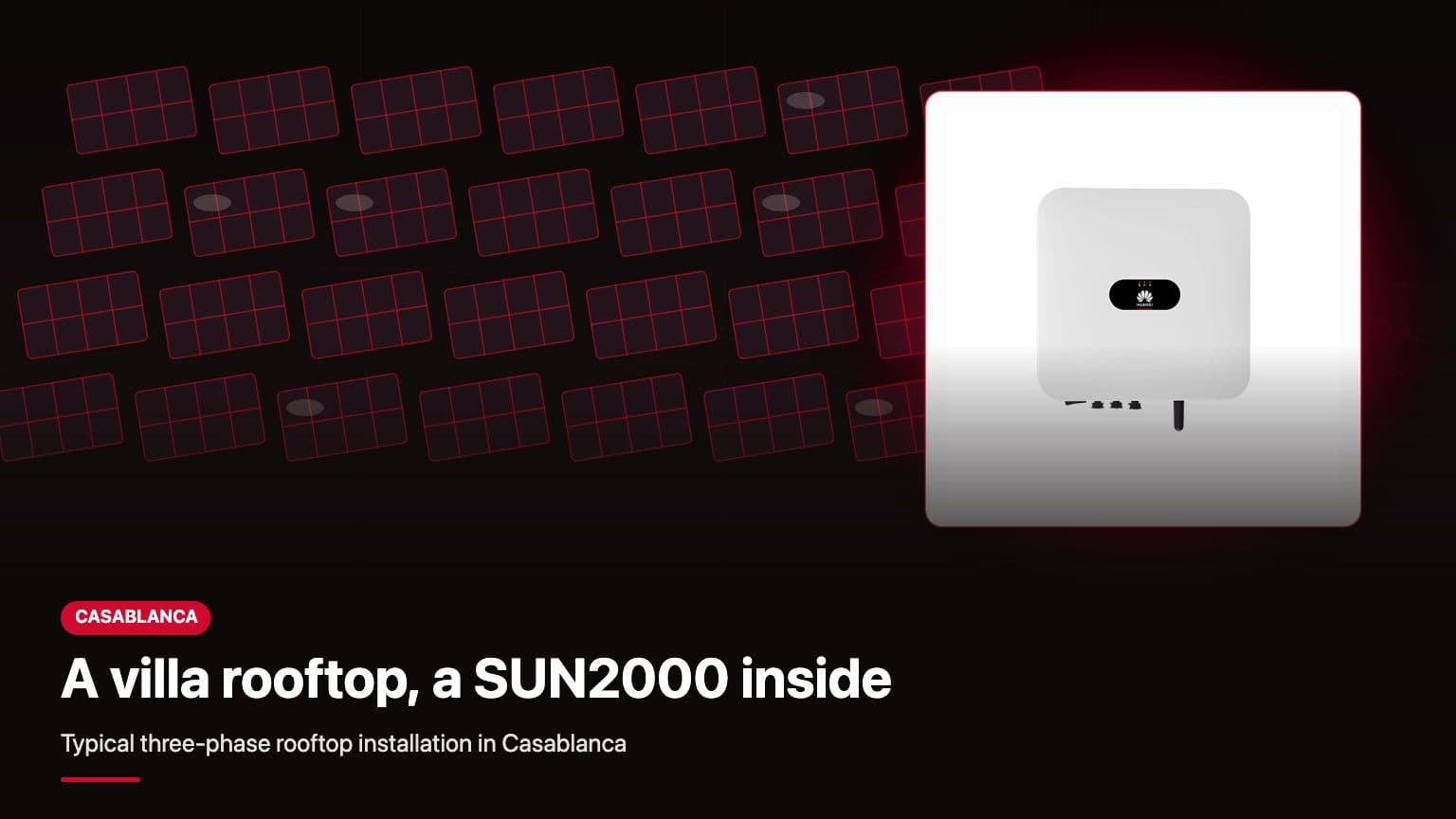
This is the part most homeowners worry about. In practice, a competent installer handles all of it; your job is to know whether they're doing it correctly. Here is the 2026 workflow:
- Pre-application site visit and design. Your installer measures roof, calculates load, and produces a single-line diagram with the exact Huawei model numbers (SUN2000-XKTL-X, LUNA2000-X-S0).
- Dossier submission to ONEE regional agency. The dossier includes: civil status, ONEE bill copy, property deed or lease, single-line diagram, equipment datasheets, installer credentials. Approved equipment list verification happens here — SUN2000 models are on the list, but verify the exact suffix.
- ONEE technical review. Typically 4–8 weeks in 2026. ONEE checks the protection settings, anti-islanding compliance, and three-phase balance for systems above 5 kW.
- Connection agreement (convention de raccordement). Signed between you and ONEE. Defines the export tariff, the metering arrangement, and the term (typically 20 years).
- Installation. Once the agreement is signed, your installer can mount panels, the SUN2000 inverter, the LUNA2000 batteries, and the wiring.
- Commissioning and bidirectional meter swap. ONEE technician witnesses the commissioning, verifies the anti-islanding test, and swaps your meter for a bidirectional unit. The system goes live the same day.
- First credited bill. Within 1–2 monthly cycles, your ONEE bill will show export credits net of consumption.
End-to-end timeline: 8–14 weeks from dossier submission to first credited bill, depending on regional ONEE agency workload. Casablanca and Rabat are faster (8–10 weeks); Marrakech and southern provinces tend to run 10–14 weeks.
What drives the installed cost of a Huawei system in Morocco
Installed prices vary by installer, city, and panel/battery brand choice.
Several Moroccan factors affect the total:
- Customs and VAT: renewable energy equipment receives reduced VAT (10% instead of 20%) under Law 13-09. Confirm your installer applies the reduced rate.
- Mounting: tile roofs (common in older medinas) need more mounting hardware than flat concrete roofs.
- Optimisers: Huawei panel optimisers are an added cost and are recommended for any roof with intermittent shading (palm trees, neighbour walls).
Ready to buy? Pick the model in the catalogue and order it online.
Mistakes to avoid when picking a Huawei system in Morocco
- Skipping the bidirectional meter step. Installing a system without the ONEE meter swap means you're either off-grid by default or technically illegal. The meter is the legal foundation of net billing.
- Using a single-phase inverter on a three-phase service. Most villas above 6 kW peak draw are wired three-phase. A single-phase SUN2000-5KTL-L1 will unbalance the supply and ONEE will reject the dossier. Confirm your supply phase before ordering.
- Cheap battery chemistry. NMC batteries are cheaper than LFP but degrade faster in Moroccan summer heat. LUNA2000 uses LFP for a reason — pay the premium.
- Oversizing the inverter relative to the panels. A 10 kW inverter on a 7 kW array wastes 30% of your inverter capital. Aim for a DC/AC ratio between 1.1 and 1.3.
- Ignoring shading on Fes/Marrakech medina rooftops. Dense urban geometry means partial shading is the norm, not the exception. Without panel optimisers, a single shaded panel can drop string output by 30%.
- Skipping the FusionSolar setup. The monitoring app is your tool to catch problems early. Installers who don't set up the app properly leave you blind.
- Using a non-listed installer. ONEE will not approve a dossier from an installer outside its qualified contractor list. Verify before signing anything.
FAQs
Is Huawei approved by ONEE for net metering in Morocco?
Yes. The Huawei SUN2000 residential and commercial inverter series is on ONEE's approved equipment list for low-voltage and medium-voltage interconnection under Law 13-09 and Law 40-19. Your installer must include the exact model number and IEC 62116 anti-islanding certificate when submitting the dossier.
How much does a 5 kW Huawei system cost in Morocco?
The installed cost of a 5 kW system depends on the installer, the city, the roof and the panel brand. The current price of the SUN2000-5KTL-L1 inverter and of the LUNA2000 battery is shown on each product page. Reduced renewable VAT of 10% applies.
Can a Huawei SUN2000 run in Marrakech summer heat?
Yes. The SUN2000 M1 and M5 series are rated for −25°C to +60°C ambient, with derating starting at 45°C. In a Marrakech July (40–44°C ambient on a shaded north wall), expect under 5% derating. Mount the inverter on a shaded exterior wall, never in direct afternoon sun, and never inside a closed garage without ventilation.
How long does ONEE take to approve a residential solar dossier?
In 2026, expect 8–14 weeks from dossier submission to first credited bill. Casablanca and Rabat regional agencies run 8–10 weeks; Marrakech and southern provinces typically 10–14 weeks. Atlas and Sahara provinces can run longer due to meter logistics.
What is the difference between ONEE and MASEN?
ONEE (Office National de l'Electricité et de l'Eau Potable) is the national distribution utility — it owns your meter and your interconnection. MASEN (Moroccan Agency for Sustainable Energy) handles utility-scale renewable procurement, including the Noor Ouarzazate complex, Noor Midelt and Noor Atlas tenders. For residential solar, you deal only with ONEE.
Do I need a battery (LUNA2000) or can I just export to ONEE?
Technically you can run a grid-tie-only SUN2000 system, but the export tariff is significantly lower than the import tariff under the current net-billing scheme. A LUNA2000 battery lets you self-consume your daytime generation in the evening at full retail value.
What warranty does Huawei give in Morocco?
SUN2000 inverters carry a 2-year warranty and LUNA2000 batteries a 5-year warranty, as stated on each product page. Warranty service is handled through authorised distributors in Casablanca, Rabat and Marrakech; replacement inverters are supplied from Casablanca stock.
Next steps
🔧 Technical references: Huawei SUN2000 datasheets and LUNA2000 installation manuals are available from your authorised distributor or directly through the FusionSolar app.
To scope your villa quickly, take your ONEE bill and the roof area into Build My System for a sized SUN2000 + LUNA2000 configuration, then order it — every unit is priced.
For after-sales help, our contact page lists our phone and email.
Frequently Asked Questions
Is Huawei approved by ONEE for net metering in Morocco?
How much does a 5 kW Huawei system cost in Morocco in 2026?
Can a Huawei SUN2000 run in Marrakech summer heat?
How long does ONEE take to approve a residential dossier?
What is the difference between ONEE and MASEN?
Do I need a LUNA2000 battery or can I just export to ONEE?
What warranty does Huawei give in Morocco?
- #huawei solar inverter morocco
- #ONEE
- #Plan Solaire Marocain
- #MASEN
- #Noor Ouarzazate
- #Casablanca solar
- #LUNA2000
- #net metering Morocco
- #FusionSolar
- #SUN2000
Ready to order?
Every unit in the catalogue carries its price — add it to the cart and order online, then collect it from our store in Dubai or Riyadh.

