Huawei Solar Inverter Oman & Sahim Program 2026: Complete Guide

Pairing a Huawei SUN2000 inverter with Oman's Sahim-2 net-metering scheme in 2026? Sizing, APSR rules, Nama interconnection, and city-by-city tips for Muscat, Salalah, Sohar & Nizwa.
If you're looking at a Huawei solar inverter in Oman and trying to plug it into the Sahim program, you're arriving at the right moment. Sahim-2 — the homeowner-procured net-metering track that the Authority for Public Services Regulation (APSR, formerly AER) opened to all residential customers in 2022 — has matured into a real, bankable scheme, and Huawei's SUN2000 residential platform is the most installed brand on Omani villa roofs today.
This guide is written for Omani villa owners, EPC installers, and small commercial buyers across Muscat, Salalah, Sohar, and Nizwa. We'll cover which Huawei model fits which villa, how the Sahim-2 application actually works with Nama Group's three distribution arms (Mazoon, Majan, Muscat Electricity), and where homeowners typically lose money on the wrong sizing.
To buy, open the catalogue, add the model to the cart and check out online.
Products mentioned in this article
Huawei 10 kWh 450 V Lithium Solar Battery LUNA2000-10-S0


- Usable Capacity
- 10 kWh
- Nominal Voltage (Single-Phase)
- 450 V
- Operating Voltage (Single-Phase)
- 350-560 V
Price incl. VATAED 5,996
Huawei 5 kWh 450 V Lithium Solar Battery LUNA2000-5-S0
- Usable Capacity
- 5 kWh
- Nominal Voltage (Single-Phase)
- 450 V
- Operating Voltage (Single-Phase)
- 350-560 V
Price incl. VATAED 3,228
Huawei 8 kW Three-Phase On-Grid Solar Inverter SUN2000-8KTL-M1

- Rated AC Power
- 8000 W
- Max DC Voltage
- 1100 V
- Operating Voltage Range
- 140-980 V
Price incl. VATAED 4,616
Huawei 10 kW Three-Phase On-Grid Solar Inverter SUN2000-10KTL-M1
- Rated AC Power
- 10000 W
- Max DC Voltage
- 1100 V
- Operating Voltage Range
- 140-980 V
Price incl. VATAED 4,847
Huawei 12 kW Three-Phase On-Grid Solar Inverter SUN2000-12KTL-M5

- Max DC Voltage
- 1100 V
- MPPT Voltage Range
- 200-1000 V
- No. of MPPTs
- 2
Price incl. VATAED 5,309
Huawei 3 kW Single-Phase On-Grid Solar Inverter SUN2000-3KTL-L1

- Max DC Voltage
- 600 V
- Startup Voltage
- 100 V
- MPPT Voltage Range
- 90-560 V
Price incl. VATAED 2,366
In a hurry? The 30-second answer
For a typical Omani villa (3-4 bedrooms, 2-3 split ACs, monthly bill OMR 35-80), the Huawei SUN2000-8KTL-M1 three-phase residential inverter paired with a LUNA2000-5-S0 or LUNA2000-10-S0 battery is the strongest 2026 pick. It's listed on the APSR-approved equipment registers used by Nama's distribution companies, supports 1:1 export credit under Sahim-2 net metering, and handles Muscat's 48 °C summer ambient with controlled derating thanks to its IP65 fanless design.
If you live in coastal Salalah (high khareef humidity) or Sohar (industrial dust), the sizing and mounting changes slightly — we'll walk through those exceptions further down.
What the Sahim program actually is (Sahim-1 vs Sahim-2)
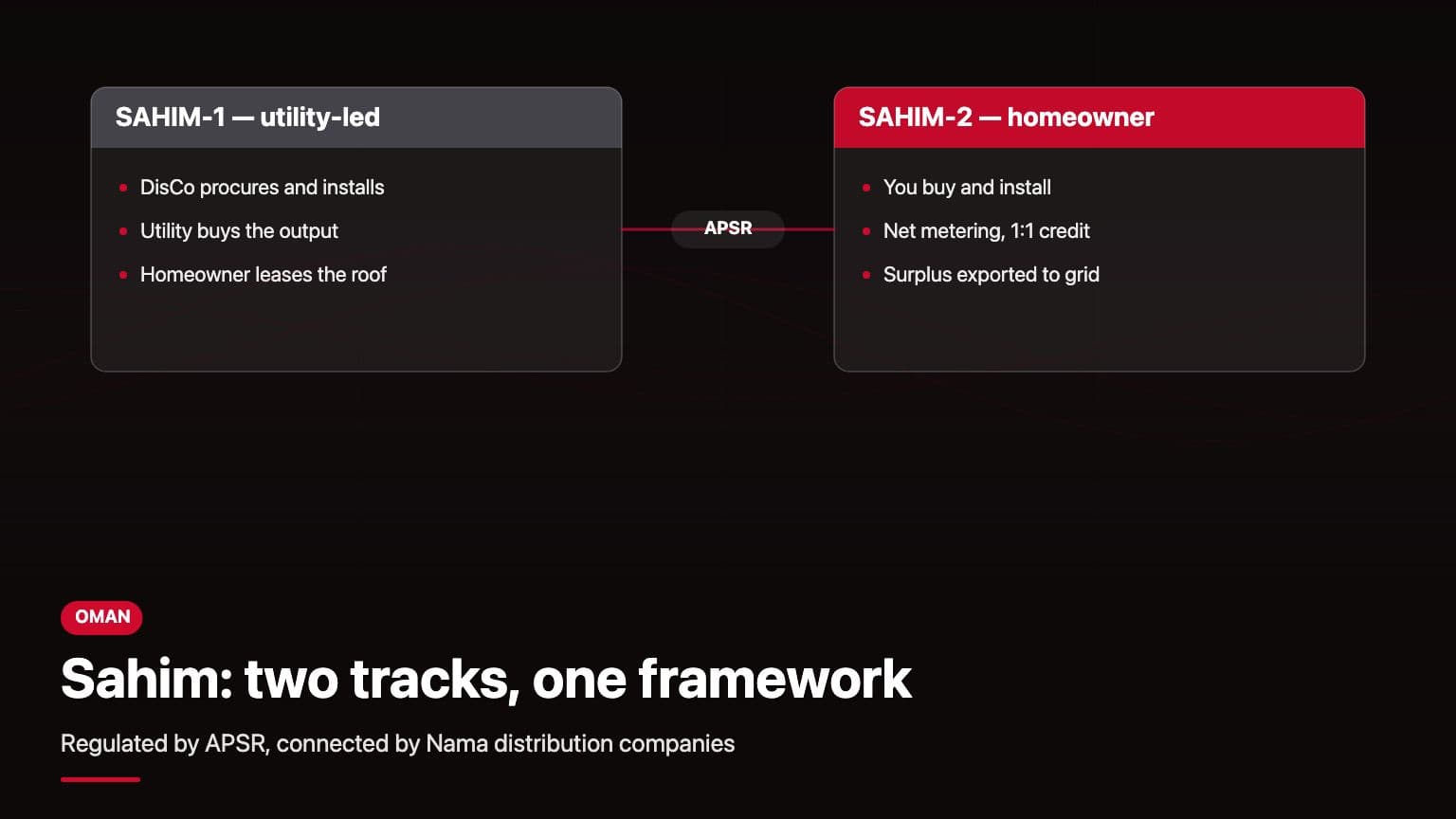
Sahim (Arabic for "contribute") is Oman's national residential rooftop solar initiative. It launched in 2017 and was substantially expanded in 2022, with the regulatory remit transferring from the former Authority for Electricity Regulation (AER) to the new Authority for Public Services Regulation (APSR). It runs on two tracks, and homeowners often confuse them:
- Sahim-1 (utility-led): the licensed distribution company (Mazoon, Majan, or Muscat Electricity) procures and installs the PV system on the homeowner's rooftop, then sells the electricity generated to the utility. The homeowner is effectively a landlord, receiving a small lease payment for the roof space.
- Sahim-2 (homeowner-procured): the homeowner buys and installs the PV system themselves (through an approved installer), connects it under net metering, and uses the energy on-site. Any surplus is exported to the grid and credited 1:1 against future import bills.
If you're reading this article, you almost certainly want Sahim-2. That's where Huawei equipment, net-metering economics, and Vision 2040 incentives intersect in a way that makes financial sense for a private villa.
Why Huawei specifically for Omani conditions
Three things make Huawei's SUN2000 family the dominant residential choice in Oman in 2026:
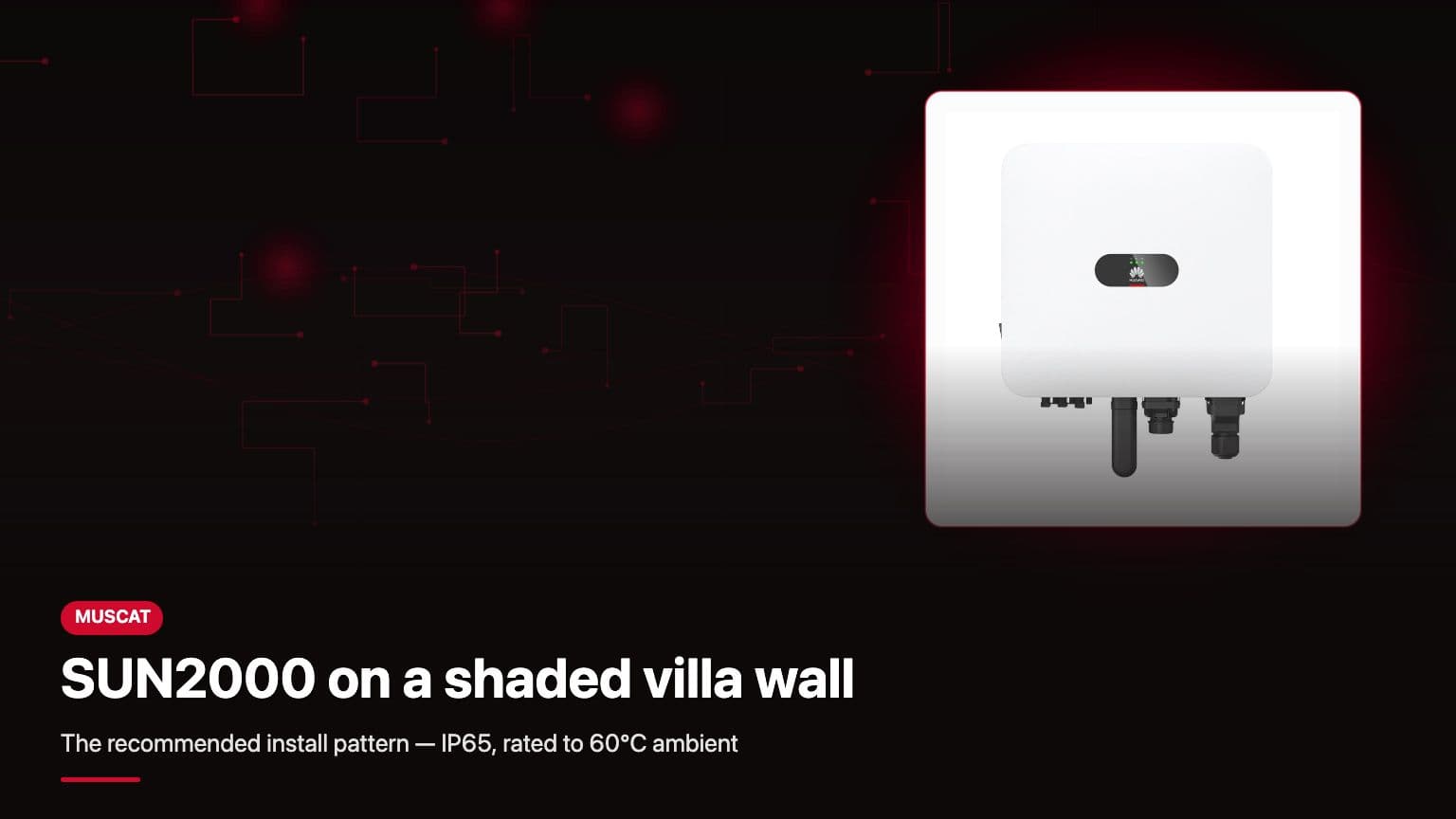
1. Heat and dust tolerance. The SUN2000 single-phase L1 series and three-phase M1 series are IP65, fanless, and rated to 60 °C ambient. In a Muscat summer, where rooftop ambient routinely sits at 50-55 °C in July and August, this matters more than peak panel wattage.
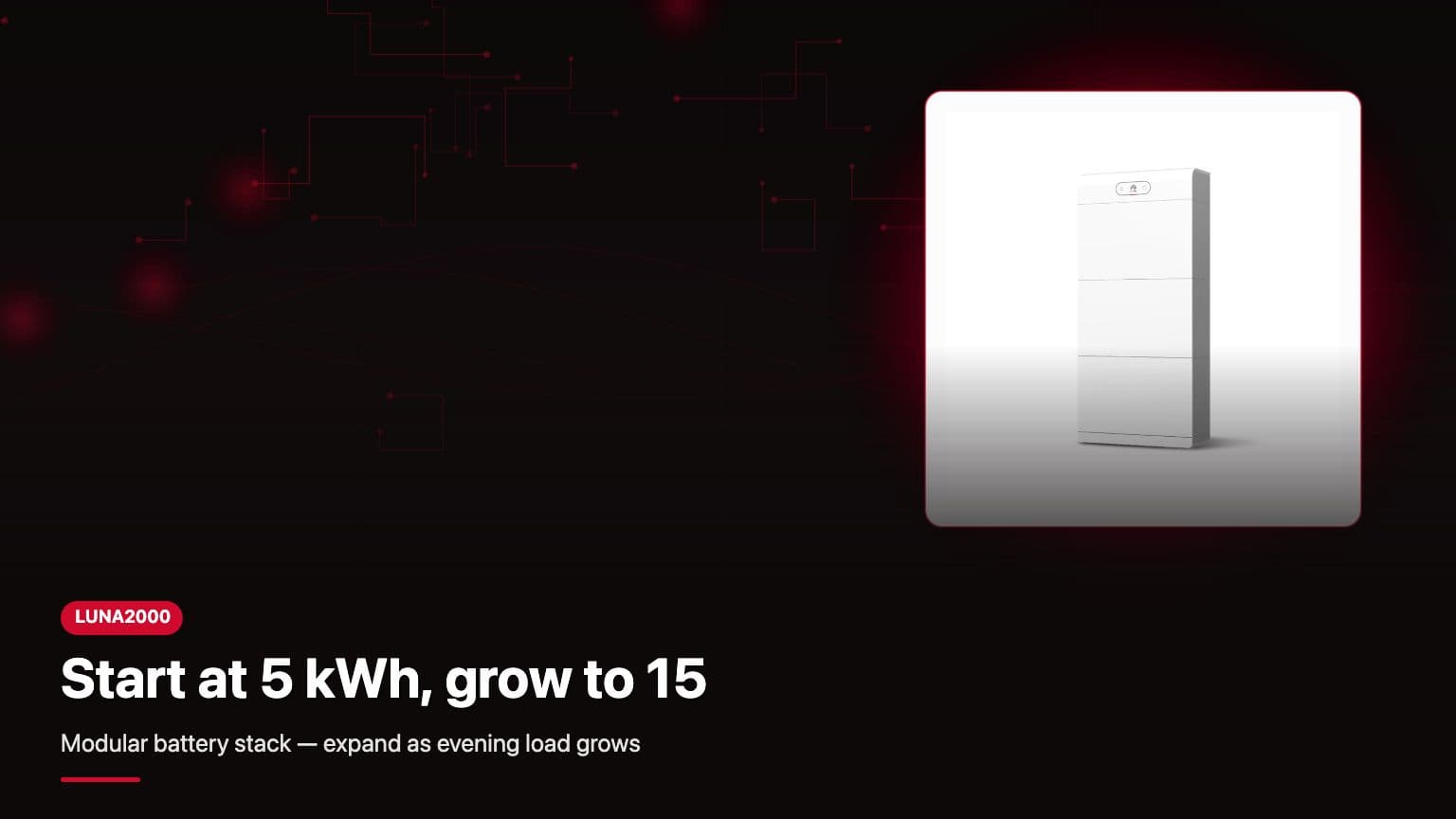
2. LUNA2000 battery integration. The LUNA2000-5-S0 (5 kWh) and LUNA2000-10-S0 (10 kWh) modular LiFePO₄ batteries pair natively with the SUN2000 hybrid, with no external coupling hardware. Stack up to three modules per tower for 5-15 kWh of usable capacity. This matters in Oman because Nama tariffs penalise high evening import (post-sunset AC load), and self-consumption from storage is materially cheaper than grid import after 6 PM.
3. APSR / Nama equipment registration. Huawei residential models are on the approved inverter registers that Nama's three distribution arms consult during the Sahim-2 connection approval. Your installer files the model number, certificate, and grid-code compliance documentation — and Huawei units sail through this step with predictable timelines.
Which Huawei model fits which Omani villa?
Sizing is a function of three numbers: your monthly Nama bill in OMR, your peak simultaneous AC load, and your roof's usable south- and west-facing area. Here's the lookup that matches Huawei's residential SUN2000 lineup to typical Omani villa profiles:
| Villa profile | Monthly bill (OMR) | Recommended Huawei inverter | Recommended battery | Typical PV array |
|---|---|---|---|---|
| Small villa, 2 bedrooms, 1-2 ACs | 15-30 | SUN2000-3KTL-L1 (3 kW single-phase) | LUNA2000-5-S0 (5 kWh) | 3-4 kWp |
| Mid-size villa, 3 bedrooms, 2 ACs | 30-55 | SUN2000-5KTL-L1 (5 kW single-phase) | LUNA2000-5-S0 or 10-S0 | 5-7 kWp |
| Standard villa, 3-4 bedrooms, 2-3 ACs | 50-90 | SUN2000-8KTL-M1 (8 kW three-phase) | LUNA2000-10-S0 (10 kWh) | 8-10 kWp |
| Large villa, 5+ bedrooms, 3-4 ACs | 90-150 | SUN2000-10KTL-M1 (10 kW three-phase) | LUNA2000-10-S0 + 5 kWh module | 10-12 kWp |
| Estate / compound | 150+ | SUN2000-12KTL-M5 (12 kW three-phase) | 2 × LUNA2000-10-S0 stacks | 12-15 kWp |
Treat these as starting points. Roof orientation, shading from neighbouring villas, and your evening AC schedule will shift recommendations by 15-25%. A west-facing roof in Sohar will produce differently from a south-facing roof in Nizwa — and the inverter sizing follows.
The Sahim-2 approval steps with Nama
The Sahim-2 application process is administratively the same across Mazoon (interior and Al Batinah South), Majan (Al Batinah North, Dhahirah, Buraimi), and Muscat Electricity (Muscat governorate), though the local engineering office handling your file changes. Salalah is served by Dhofar Power Company under a parallel arrangement. Here's the path from purchase order to first export:
- Choose an approved installer. APSR maintains a list of qualified PV contractors authorised to file Sahim-2 connections. Your installer must hold valid electrical contracting credentials in Oman.
- System design and quote in OMR. The installer surveys your roof, sizes the system, and submits a design package including the Huawei model numbers (SUN2000 + LUNA2000), single-line diagram, and structural mounting plan.
- Sahim-2 connection application. Your installer files the application with your distribution company. The package includes the APSR-registered inverter certificate, panel datasheets, and an undertaking signed by the homeowner.
- Technical approval. The DisCo's engineering office reviews the application. Typical turnaround is 4-8 weeks depending on the company and the time of year. Files spike during the cooler October-March window.
- Installation and commissioning. Once approved, the installer carries out the physical work. Huawei FusionSolar app commissioning takes about an hour on site.
- Bidirectional meter swap and witness test. The DisCo dispatches an engineer to install the bidirectional Nama meter and witness the inverter's anti-islanding test. After sign-off, the system is officially energised under Sahim-2.
- First net-metered bill. Your next Nama bill will show separate import and export readings, with the credit applied 1:1 against import consumption.
Order online: every model in the catalogue shows its price, and checkout takes a minute.
What a Huawei + LUNA2000 system costs in Oman
Installed prices vary by installer and by city. The current price of each SUN2000 inverter and LUNA2000 battery is shown on its product page.
Average Omani solar irradiance is roughly 2,100-2,200 kWh/kWp/year. Salalah is at the lower end of that range because of summer khareef cloud cover; Nizwa and the Al Dhahirah interior at the higher end thanks to clearer skies.
City-by-city notes for Omani installations
Muscat & Seeb
Coastal humidity is the dominant stress factor. Mount the SUN2000 on a shaded outdoor wall — not in a sealed utility room — and specify Tier-1 panels with anti-PID and anti-corrosion frames. The Muscat Electricity distribution office is the busiest Sahim-2 filer in the country, so factor 6-8 weeks for technical approval.
Sohar & Al Batinah North
Industrial dust from the port and the free zone shortens panel cleaning intervals to roughly every 6-8 weeks. The Huawei inverter itself, being IP65 fanless, is unaffected. Majan Electricity files tend to move faster than Muscat's — typical approval in 4-6 weeks.
Nizwa & the Interior
Best irradiance in the country, but ambient peaks above 50 °C are common in July. Place the inverter on a north or east wall in shade; do not direct-mount on the south wall. Mazoon Electricity covers this region.
Salalah & Dhofar
The khareef monsoon (June-September) drops irradiance by 30-40% during cloud cover. System sizing should account for this seasonal trough — homeowners who size only on the dry-season average will be disappointed in August. Dhofar Power Company handles connections separately from Nama's three mainland arms.
How Huawei plugs into Oman Vision 2040
Oman has set a target of 30% renewable generation by 2030 as part of Vision 2040, and the Sahim program is the principal residential lever to get there. The country's flagship utility-scale project, the 1.65 GW Ibri II solar plant in Al Dhahirah, supplies the bulk-grid renewable share, but the Sahim rooftop programme is what scales solar across hundreds of thousands of villas. For an individual homeowner, choosing a SUN2000 + LUNA2000 system today means buying into a fleet that's already proven in the local heat, the local regulatory regime, and the local Nama interconnection process.
Mistakes to avoid when picking a Huawei + Sahim setup in Oman
- Oversizing without a battery. Pushing a 10 kW system onto the grid without storage means most of your generation is exported at 1:1 credit — fine, but you're foregoing the evening self-consumption value that pays back the system faster. Pair the inverter with at least 5 kWh of LUNA2000.
- Mounting the inverter inside a hot utility room. Even an IP65 fanless unit needs ambient air movement. The SUN2000 wants a shaded outdoor wall, not a 55 °C enclosed cupboard.
- Skipping the APSR-registered installer step. Self-installed or unregistered installations don't qualify for Sahim-2 net metering. The system will be technically illegal and won't be billed bidirectionally.
- Ignoring the khareef in Salalah. Sizing on a dry-season generation estimate will leave Dhofar homeowners under-producing for 3-4 months a year.
- Buying from grey-market resellers. Huawei warranty service in Oman runs through authorised channels. A grey-market SUN2000 is functionally identical until it fails — at which point you're outside the regional RMA network.
- Sizing the array too small relative to the inverter. A SUN2000-8KTL-M1 paired with a 5 kWp array is 3 kW of wasted inverter capacity. Aim for a DC/AC ratio of 1.1-1.3.
Frequently asked questions
Below are the most common questions Omani homeowners ask before committing to a Huawei + Sahim-2 installation.
Order online: every model in the catalogue shows its price, and checkout takes a minute.
For an Omani home the villa system with evening backup is a close starting point, the sizing calculator applies Oman's 5.7 peak sun hours to your own appliances, and the SUN2000 L1 vs M1 comparison answers the single- or three-phase question your supply sets.
Frequently Asked Questions
What is the Sahim program in Oman?
Which Huawei inverter is best for an Omani villa?
How much does a Huawei solar system cost in Oman in 2026?
Does Sahim-2 in Oman use real net metering?
How long does Sahim-2 approval take with Nama?
Can Huawei SUN2000 inverters handle Oman's summer heat?
What is the warranty on Huawei SUN2000 inverters in Oman?
- #huawei solar inverter oman
- #Sahim program
- #Sahim-2
- #Oman solar
- #Nama Group
- #APSR
- #Muscat solar
- #LUNA2000
- #SUN2000
- #net metering Oman
Ready to order?
Every unit in the catalogue carries its price — add it to the cart and order online, then collect it from our store in Dubai or Riyadh.


