Huawei Solar Inverter Qatar 2026: Kahramaa Guide & Sizing

Choosing a Huawei solar inverter in Qatar in 2026? Full guide to Kahramaa interconnection, Vision 2030 targets, Doha villa sizing, LUNA2000 batteries and FusionSolar.
If you're shopping for a Huawei solar inverter in Qatar in 2026, the rules have changed since Kahramaa opened its rooftop solar interconnection scheme. Qatar's National Vision 2030 targets 4 GW of solar by 2030, the 800 MW Al Kharsaah plant is already feeding the grid, and Kahramaa is actively certifying residential and commercial PV installs across Doha, Al Wakrah, Al Rayyan and Lusail.
This guide is built for Qatari villa owners, compound developers, and Kahramaa-licensed EPC installers. We cover the SUN2000 single- and three-phase inverters, LUNA2000 battery storage, FusionSolar monitoring and Kahramaa interconnection paperwork.
Ready to buy? Pick the model in the catalogue and order it online.
Products mentioned in this article
Huawei 10 kWh 450 V Lithium Solar Battery LUNA2000-10-S0


- Usable Capacity
- 10 kWh
- Nominal Voltage (Single-Phase)
- 450 V
- Operating Voltage (Single-Phase)
- 350-560 V
Price incl. VATAED 5,996
Huawei 10 kW Three-Phase On-Grid Solar Inverter SUN2000-10KTL-M1

- Rated AC Power
- 10000 W
- Max DC Voltage
- 1100 V
- Operating Voltage Range
- 140-980 V
Price incl. VATAED 4,847
Huawei 15 kWh 450 V Lithium Solar Battery LUNA2000-15-S0
- Usable Capacity
- 15 kWh
- Nominal Voltage (Single-Phase)
- 450 V
- Operating Voltage (Single-Phase)
- 350-560 V
Price incl. VATAED 8,777
Huawei 20 kW Three-Phase On-Grid Solar Inverter SUN2000-20KTL-M5

- Max DC Voltage
- 1100 V
- MPPT Voltage Range
- 200-1000 V
- No. of MPPTs
- 2
Price incl. VATAED 6,636
Huawei 15 kW Three-Phase On-Grid Solar Inverter SUN2000-15KTL-M5
- Max DC Voltage
- 1100 V
- MPPT Voltage Range
- 200-1000 V
- No. of MPPTs
- 2
Price incl. VATAED 5,593
Huawei 5 kW Single-Phase On-Grid Solar Inverter SUN2000-5KTL-L1

- Max DC Voltage
- 600 V
- Startup Voltage
- 100 V
- MPPT Voltage Range
- 90-560 V
Price incl. VATAED 2,801
In a hurry? The 30-second answer
For a typical Doha villa (4–6 bedrooms, 4–6 split ACs, monthly Kahramaa bill 1,200–2,800 QAR), the Huawei SUN2000-10KTL-M1 three-phase hybrid inverter paired with a LUNA2000-10-S0 battery is the strongest 2026 pick. It runs to 60°C ambient, carries IP65 protection for Qatar's coastal humidity and shamal dust, supports Kahramaa's net-metering grid code, and integrates with the FusionSolar app for live production tracking — useful when Tarsheed (Kahramaa's conservation programme) audits your consumption.
Smaller villas can drop to the SUN2000-5KTL-L1 single-phase; larger compounds step up to the SUN2000-15KTL-M5 or SUN2000-20KTL-M5. Skip to the sizing table or read on for the reasoning.
Why solar matters in Qatar right now
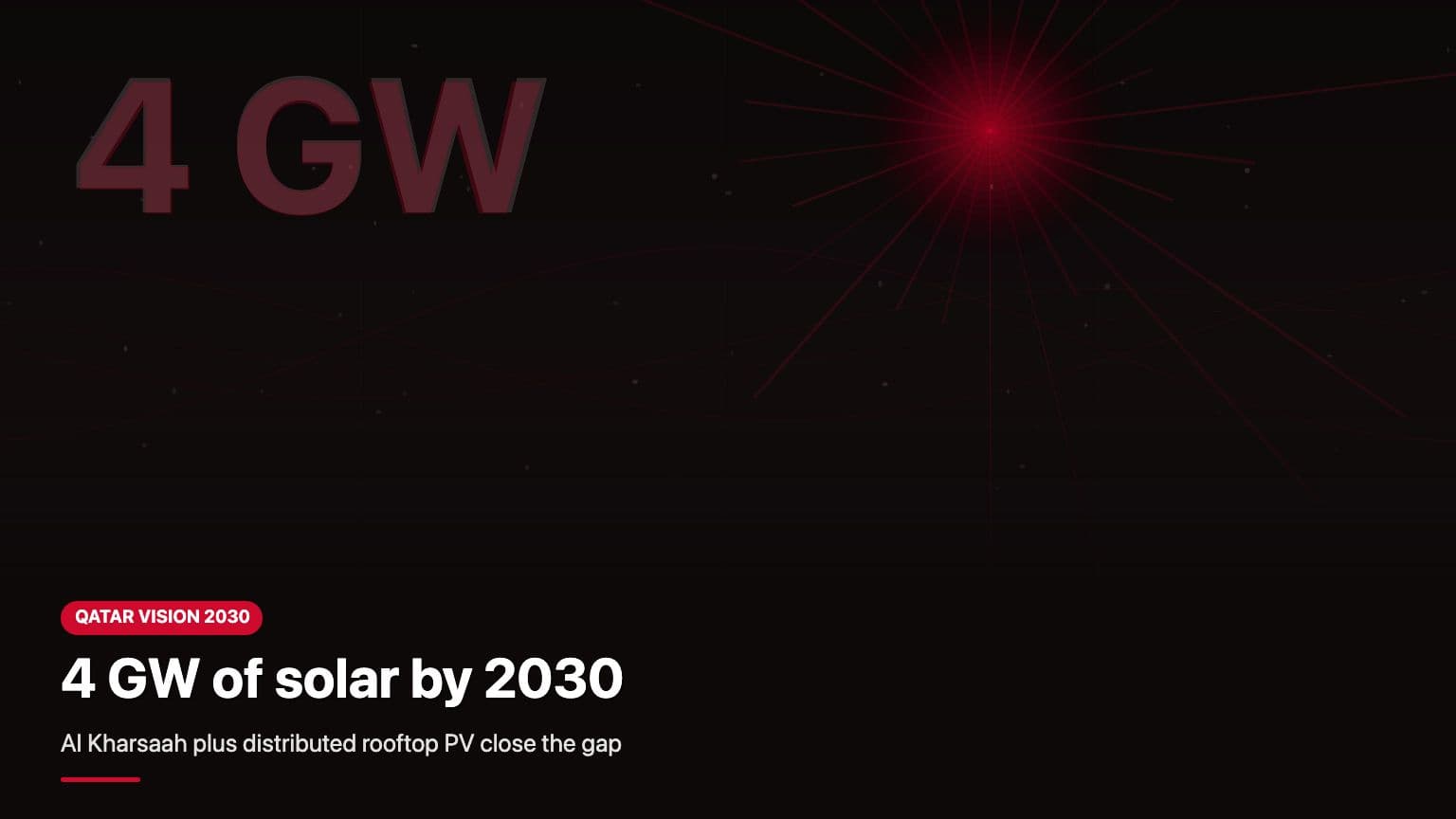
Three forces are pushing rooftop solar into mainstream Qatar in 2026:
1. Qatar National Vision 2030 and the Qatar Solar Energy strategy. The 4 GW target by 2030 means utility-scale plants like the 800 MW Al Kharsaah facility (commissioned in late 2022 and now feeding ~10% of national peak demand) are no longer the whole story. Kahramaa expects distributed rooftop PV to contribute meaningfully toward the residual gap to 4 GW.
2. Tarsheed and consumption pressure. Kahramaa's Tarsheed conservation programme — including the annual Tarsheed Conservation Awards — is leaning hard on villa owners with high consumption. A Doha villa running 6 split ACs through a 50°C summer can easily exceed 5,000 kWh/month. Rooftop solar is now the most direct route to cutting that bill while staying out of the high tariff brackets.
3. The Kahramaa interconnection scheme. Qatar's net-metering framework, while newer than DEWA's in the UAE or SEC's in Saudi Arabia, is now operational. Approved EPCs can register a residential PV install, commission a bidirectional meter, and start exporting surplus generation back to the Kahramaa grid.
Kahramaa regulations: what the law actually requires
Kahramaa (the Qatar General Electricity & Water Corporation) regulates every grid-tied PV install in the country. The framework is closely modelled on the GCC small-scale solar template but with a few Qatar-specific twists. Here's what matters before you buy hardware:
1. EPC licensing
The installer must hold a valid Kahramaa contractor licence in the relevant electrical class. DIY installs are not eligible for interconnection and will not pass the bidirectional meter inspection. Always ask for the licence number before signing a contract.
2. Approved equipment list
Kahramaa maintains an approved-equipment list for inverters and modules. Huawei's SUN2000-KTL-M1, SUN2000-KTL-M5 and SUN2000-KTL-L1 series are listed; LUNA2000 batteries are accepted as DC-coupled storage behind a listed inverter. Confirm the exact model on the latest list when you apply — the list refreshes quarterly.
3. Grid code compliance
The inverter must implement anti-islanding (IEEE 1547-style), low-voltage ride-through, and frequency-droop curves that match Kahramaa's grid code. All listed Huawei SUN2000 models ship with the Qatar regulation profile pre-loaded in FusionSolar.
4. System size cap
Residential rooftop is currently capped to a system size that matches the customer's contracted load (typically 10–25 kVA for a villa). Commercial caps are higher but require additional Kahramaa engineering review.
5. Net-metering settlement
Qatar's scheme settles surplus exports against imports on a monthly basis. Unlike older European net-metering schemes, there is no cash payout — credits roll over but eventually expire. This means self-consumption + storage (battery) makes more economic sense than oversizing for export.
Order online: every model in the catalogue shows its price, and checkout takes a minute.
Why Huawei specifically for the Qatari market
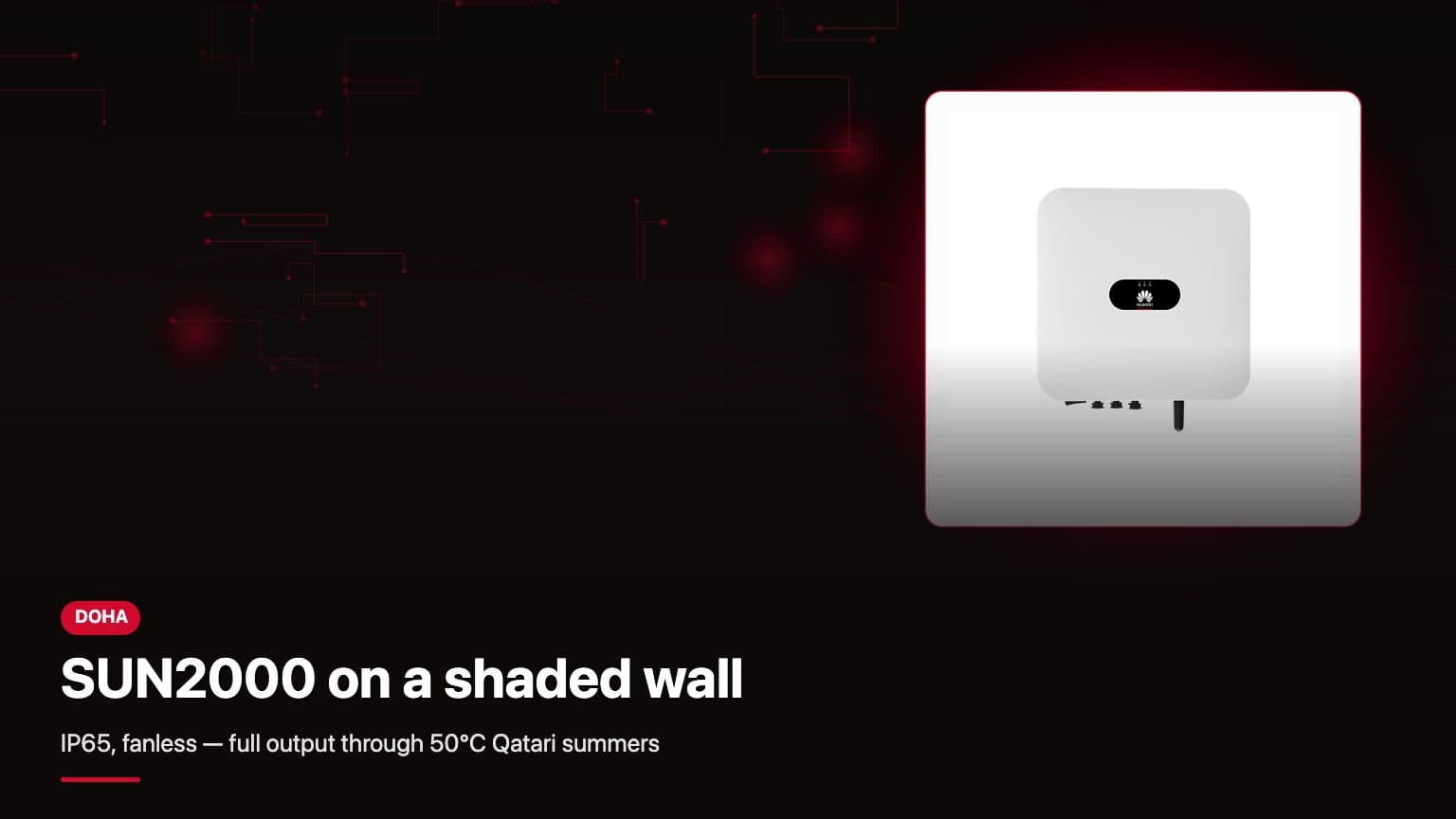
Qatar's climate punishes inverters harder than almost any market on earth. Doha summers regularly cross 50°C ambient, coastal humidity along the West Bay corridor stays above 70% from June through September, and shamal winds drive fine sand into every exposed seal. Huawei's SUN2000 range is one of the few inverter families that survives these conditions without a step-down in production. Here's why:
SUN2000: temperature, IP65, and the smart string design
- Operating range: −25°C to +60°C ambient, with derating starting at 45°C. In Qatar that means full output through 99% of summer daylight hours when wall-mounted in shade.
- IP65 enclosure: dust-tight + protected from water jets. The sealed connector design handles humidity cycling and shamal grit without internal corrosion.
- Smart string architecture: per-string MPPT (typically 2–6 channels depending on model) keeps soiled or partially shaded panels from dragging down the array — important when shamal dust coats only the windward edge of a Doha rooftop.
- Arc-fault detection: built-in AFCI cuts DC fault risk on hot rooftops where cable insulation degrades faster.
LUNA2000 storage
The LUNA2000-5-S0, LUNA2000-10-S0 and LUNA2000-15-S0 batteries are modular LiFePO₄ packs that stack to 5–30 kWh. They're DC-coupled behind a SUN2000 hybrid inverter, which means no extra conversion losses and a single FusionSolar app for both production and storage telemetry. Key Qatar-relevant specs:
- Operating to 55°C with active thermal management (essential for a hot Doha utility room).
- 5-year warranty, as stated on the product page.
- Pack-level battery optimisers — one weak module doesn't reduce the rest of the stack.
FusionSolar monitoring
FusionSolar is the strongest monitoring app in the industry. It supports Arabic, provides 5-minute production granularity, and — crucially for Qatari compliance — generates the production reports Kahramaa sometimes requests during net-metering audits.
Sizing for Qatari villas: which Huawei inverter fits
Qatari load profiles run heavier than the GCC average because AC duty cycles are longer (peak summer cooling can run 16+ hours/day). Use this as your starting point:
| Doha home profile | Monthly Kahramaa bill (QAR) | Recommended Huawei inverter | LUNA2000 battery |
|---|---|---|---|
| Small villa, 2–3 bedrooms, 2–3 ACs | 500–900 | SUN2000-5KTL-L1 (single-phase hybrid) | LUNA2000-5-S0 (5 kWh) |
| Mid-size villa, 4 bedrooms, 3–4 ACs | 1,000–1,800 | SUN2000-8KTL-M1 (three-phase hybrid) | LUNA2000-10-S0 (10 kWh) |
| Large Doha villa, 5+ bedrooms, 4–6 ACs | 1,800–3,200 | SUN2000-10KTL-M1 or SUN2000-12KTL-M5 | LUNA2000-10-S0 or LUNA2000-15-S0 |
| Lusail / Al Wakrah luxury villa with pool | 3,000–5,500 | SUN2000-15KTL-M5 | LUNA2000-15-S0 + 5-S0 expansion (20 kWh) |
| Compound / multi-villa | 6,000+ | SUN2000-20KTL-M5 (parallel pair) | LUNA2000 stacked to 30 kWh |
| Small commercial / shop | 3,500–8,000 | SUN2000-20KTL-M5 | LUNA2000 stacked to 15–30 kWh |
These are starting points. Roof orientation, panel choice (typically 550–620 W bifacial in Qatar), and load schedule will shift the numbers by 15–25%. A proper Kahramaa-licensed EPC will pull your last 12 months of bills before locking in the model.
Kahramaa interconnection: the seven-step process

The end-to-end process from "I want solar" to "exporting to the Kahramaa grid" runs through these seven stages. A licensed EPC handles most of them on your behalf:
- Site survey and load profile. The EPC pulls 12 months of Kahramaa bills, measures available roof area, and confirms the contracted load matches the proposed system size.
- System design and SLD. A single-line diagram (SLD) showing the SUN2000 inverter, LUNA2000 battery, panels, isolators, and grid tie-in point is prepared.
- Kahramaa application submission. The licensed EPC files the interconnection application with the SLD, datasheet PDFs for the Huawei SUN2000 and LUNA2000, and proof of the inverter's place on the approved-equipment list.
- Technical review. Kahramaa engineers review the application — typically 2–4 weeks. Compounds and commercial sites take longer.
- Installation and commissioning. Panels, inverter, battery, and AC isolator installed. FusionSolar grid profile set to "Qatar" and locked.
- Bidirectional meter swap. Kahramaa replaces the standard meter with a bidirectional unit that records both import and export.
- Net-metering goes live. Monthly settlement on the Kahramaa bill begins from the date of bidirectional commissioning.
Total realistic timeline: 6–10 weeks from contract signing to live export for a residential install, longer for compounds.
Doha heat: what 50°C actually does to your system

Plan for four effects of Doha's summer on a rooftop system:
- Inverter derating: Wall-mount the SUN2000 in shade to keep derating low; direct sun on a south-facing wall in July increases it.
- Panel performance: Tier-1 panel temperature coefficients average −0.30%/°C. At 70°C cell temperature (typical July midday), expect 12–15% production loss vs STC.
- Battery temperature management: LUNA2000's active thermal management protects cycle life in an unconditioned utility room.
- Soiling: Shamal dust events cut daily production until the panels are cleaned. Plan on monthly cleaning during sandstorm season (March–May), quarterly otherwise.
Mistakes to avoid when buying Huawei solar in Qatar
- Buying through an unlicensed installer. The cheap quote from an unlicensed contractor disqualifies you from Kahramaa interconnection. The system becomes a costly off-grid hobby project rather than a Kahramaa-credited asset.
- Skipping the LUNA2000 battery. Qatar's monthly net-metering settlement means surplus exported at midday doesn't pay you back at retail tariff. A battery captures that surplus for evening AC loads at full self-consumption value.
- Oversizing relative to your contracted load. Kahramaa caps residential system size to your contracted load. A 25 kW system on a 15 kVA-contracted villa will not pass the technical review.
- Ignoring the approved-equipment list refresh. The Kahramaa list updates quarterly. A SUN2000 model approved in Q1 may need re-verification in Q3. Always pull the current list at the time of application.
- Installing the inverter in direct sun. Even an IP65, 60°C-rated SUN2000 derates faster in direct sun. Wall-mount on a north or east-facing shaded wall, or under a roof overhang.
- Buying panels and inverter from unrelated suppliers. Huawei optimisers and FusionSolar telemetry work best when the entire DC stack is co-engineered. Use a single EPC for the full Huawei + Tier-1 panel package.
- Forgetting Tarsheed audits. If you're a high-consumption villa flagged by Tarsheed, FusionSolar reports are useful evidence that you're already on a reduction trajectory. Keep the monitoring account active.
Order online: every model in the catalogue shows its price, and checkout takes a minute.
Next steps
For after-sales help, our contact page lists our phone and email.
A Qatari villa is close to the villa system with overnight backup; the sizing calculator uses Qatar's 5.6 peak sun hours, and the Huawei vs SMA comparison page sets Huawei against SMA record by record.
Frequently Asked Questions
Is Huawei solar approved by Kahramaa in Qatar?
Which Huawei inverter is best for a Doha villa?
How much does a Huawei solar system cost in Qatar in 2026?
Does Kahramaa offer net metering in Qatar?
Can Huawei SUN2000 inverters handle Doha's 50°C summers?
How long does Kahramaa interconnection take for a Huawei install?
Do I need a Kahramaa-licensed contractor for solar in Qatar?
- #huawei solar inverter qatar
- #Kahramaa
- #Doha solar
- #Qatar Vision 2030
- #LUNA2000
- #FusionSolar
- #Tarsheed
- #Al Kharsaah
- #SUN2000
Ready to order?
Every unit in the catalogue carries its price — add it to the cart and order online, then collect it from our store in Dubai or Riyadh.


