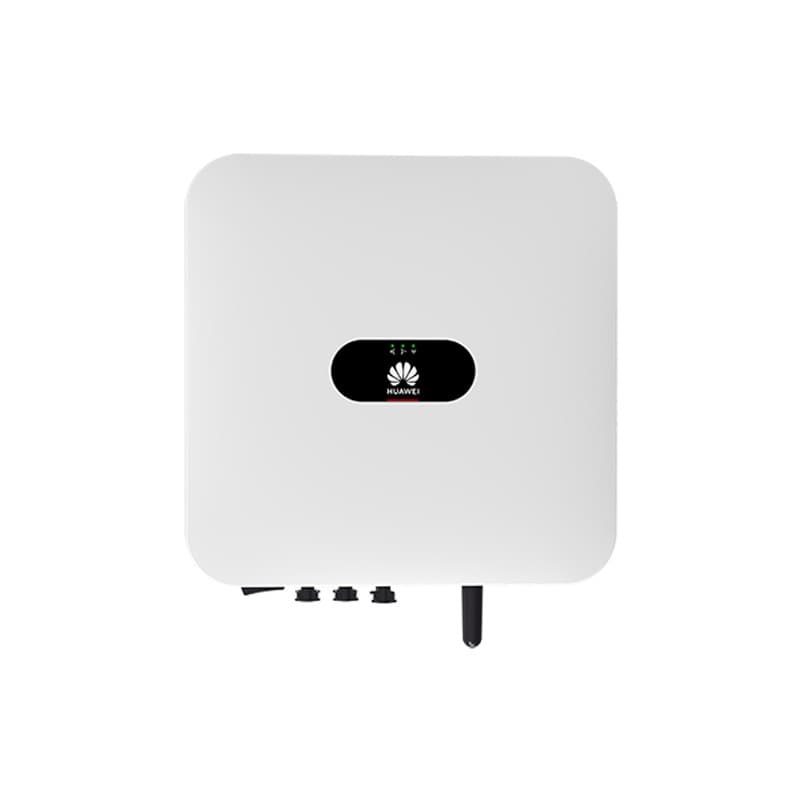
In-depth review of the Huawei SUN2000-196KTL-H0, 200KTL-H2 and 215KTL-H0 utility-scale string inverters — 1500 V, 12 MPPT, smart tracking and field data from MENA solar farms.
For utility-scale solar farms above 5 MW, the choice between central and string inverter architecture has tilted decisively toward string in the last 36 months. The Huawei SUN2000-H series — covering the 196KTL-H0, 200KTL-H2 and 215KTL-H0 — is the spec we see most often on MENA utility projects today. This is the workhorse behind dozens of 30-500 MW plants from Egypt and Morocco to Saudi Arabia and Oman.
This review walks through what makes the H series different from the M3 commercial line and the 330KTL-H2 ultra-high-power flagship, and how to plan around it for grid-tied plants under the SERA, FRSA, Masdar EPC and ACWA Power frameworks.
The H series in one paragraph
The SUN2000-196/200/215KTL-H series is Huawei's 1500 V DC, 12-MPPT, smart string inverter family targeted at utility-scale ground-mounts and large industrial rooftops. Compared to a 3-4 MW central inverter, each H unit handles a 200 to 250 kW block of the array independently. That means a 100 MW plant becomes 400-500 H units rather than 25-33 central skids — and gains independent MPPT optimisation, faster fault isolation, and tower-by-tower replaceability.
Headline specs
| Parameter | SUN2000-196KTL-H0 | SUN2000-200KTL-H2 | SUN2000-215KTL-H0 |
|---|---|---|---|
| Rated AC Power | 196 kW | 200 kW | 215 kW |
| Max DC Voltage | 1500 V | 1500 V | 1500 V |
| MPPT Voltage Range | 600-1500 V | 600-1500 V | 600-1500 V |
| Number of MPPTs | 12 | 12 | 12 |
| Strings per Inverter | 24 | 24 | 24 |
| Max Efficiency | 99.0% | 99.0% | 99.0% |
| Protection | IP66 | IP66 | IP66 |
| Cooling | Smart Air | Smart Air | Smart Air |
| Operating Temp | -30 to +60 °C | -30 to +60 °C | -30 to +60 °C |
Why 1500 V DC is the standard for utility scale
1500 V DC has displaced 1000 V as the utility-scale standard for one simple reason: at higher string voltage you push more power down the same copper. Pushing 22-26 panels in series at 1500 V cuts string count by roughly 50% versus the equivalent 1000 V design, which translates to:
- 40-45% less DC cable length
- 60% fewer combiner box ports
- 30-35% reduction in DC trenching labour
- Total BOS savings of USD 12-18 per kWp on greenfield projects
The SUN2000-H series natively supports the full 1500 V envelope without external transformers.
12 MPPT: why utility plants want this
Twelve independent MPPTs per inverter means each H unit can run 12 different operating points across its 24 strings. On a 100 MW Saudi solar farm with mild row-to-row tilt variation, dust gradient across the site, or partial cloud transit, 12-MPPT granularity recovers 1.5-2.5% of annual yield versus a 4- or 6-MPPT competitor. On a USD 60 million plant, that is USD 900,000 to 1.5 million of additional lifetime production.
Smart string monitoring at utility scale
Every string is individually metered. When paired with SmartLogger3000 and Huawei's Smart PV Management System (SmartPVMS), operators get string-level alerts on:
- Soiling beyond a configurable threshold (typically 5-8%)
- Faulty/burned-out panels (current drop > 12%)
- Module degradation trends (year-over-year drift)
- IV-curve diagnostics on demand (intelligent IV scan)
For MENA utility projects, this turns O&M from a calendar-driven model (clean everything quarterly) to a data-driven one (clean the rows that need cleaning). Verified yield improvement averages 3-5% in dusty environments.
NOA hardening for Middle East climate
The H series uses Huawei's NOA (Network Optimised Architecture) — sealed enclosure, anti-PID active mode, conformal-coated power stage, and chassis materials rated for coastal salt fog and inland dust storms. Combined with IP66 ingress protection, units have shown sub-0.5% annual failure rate across 50+ Saudi and UAE plants commissioned since 2023. The 60 °C ambient rating is genuine — derating begins at 50 °C in 196/215KTL-H0 and at 45 °C on the 200KTL-H2 (which trades a small thermal margin for a higher 200 kW rating).
Sizing example: 100 MW solar farm in Tabuk
For a 100 MW DC plant in Tabuk (NEOM region, Saudi Arabia):
- ~167,000 × 600 W bifacial panels (100.2 MW DC)
- 500 × SUN2000-200KTL-H2 = 100 MW AC (DC/AC ratio 1.00 - typical for large utility)
- Each inverter takes ~334 panels across 24 strings of 14 panels each
- String voltage at STC ~580-650 V, comfortably inside the 600-1500 V MPPT window
- 10 × SmartLogger3000 per 50-inverter cluster (5 clusters total)
- 20 × 4 MVA step-up transformers feeding 33 kV collection grid
Project commissioning timeline: 14-18 months end-to-end for a site this size.
Grid services and code compliance
The H series supports all required GCC and North African grid services:
- LVRT/HVRT to grid codes including DEWA, SEC SERA, EWA, OETC, ONEE (Morocco), EgyptERA
- Frequency-watt (P-f) and voltage-var (Q-V) response curves
- Active and reactive power dispatch from SmartLogger / SmartPVMS
- Anti-islanding to IEC 62116
- Grid-forming capability (firmware-enabled) for select markets requiring synthetic inertia
Certifications include IEC 62109-1/-2, IEC 61727, IEC 62116, EN 50549-1, UL 1741 (where required), and the regional KSA SASO mark.
Comparison with the SUN2000-330KTL-H2
The 330KTL-H2 (covered in our dedicated 330KTL review) is the next tier up — 330 kW per unit, also 1500 V, with even higher single-inverter density. Choose 330KTL-H2 when site logistics favour fewer but bigger units (large open ground-mount blocks). Stay with 196/200/215 KTL when sub-block granularity matters (rooftop megawatt, tracker-mounted farms with row-level switching, hybrid PV-storage where each block pairs with a battery container).
Pricing and lead time
List pricing for utility H series sits between USD 0.035 and USD 0.048 per watt depending on volume and grid code complexity. For an EPC ordering 500 units of 200KTL-H2 for a 100 MW project, the inverter cost lands around USD 4-4.5 million ex-works. Huawei MJS Solutions handles regional logistics, DEWA/SERA compliance docs, and commissioning support. Lead time on utility orders is typically 8-14 weeks from PO.
Verdict
For any GCC or North African solar farm above 5 MW, the SUN2000-H series should be on the shortlist. Its combination of 1500 V envelope, 12-MPPT granularity, NOA hardening for desert climates and SmartPVMS analytics defines the modern utility-scale string inverter. EPCs and IPPs running on M3-class commercial inverters and now scaling above 20 MW will find the H series the natural next step.
Frequently Asked Questions
What is the maximum DC voltage of the Huawei SUN2000-H series?
How many MPPT trackers does the SUN2000-200KTL-H2 have?
Is the Huawei H series suitable for 100 MW solar farms in Saudi Arabia?
What is the warranty on Huawei utility-scale H series inverters?
Does the SUN2000-H series support grid-forming mode?
How does the H series compare with the SUN2000-330KTL-H2?
What MPPT voltage range does the H series operate in?
Ready for a personalized quote?
WhatsApp us — average reply time under 15 minutes.
Related Products
Related Articles

Huawei SUN2000-330KTL-H2 Review: The Highest-Power String Inverter for Utility Solar
Huawei SUN2000 M3 Review (30/36/40 KTL): The Commercial Inverter Workhorse for 2026
Best Huawei Utility-Scale Solar Inverter in 2026 — H1, H2, and Beyond